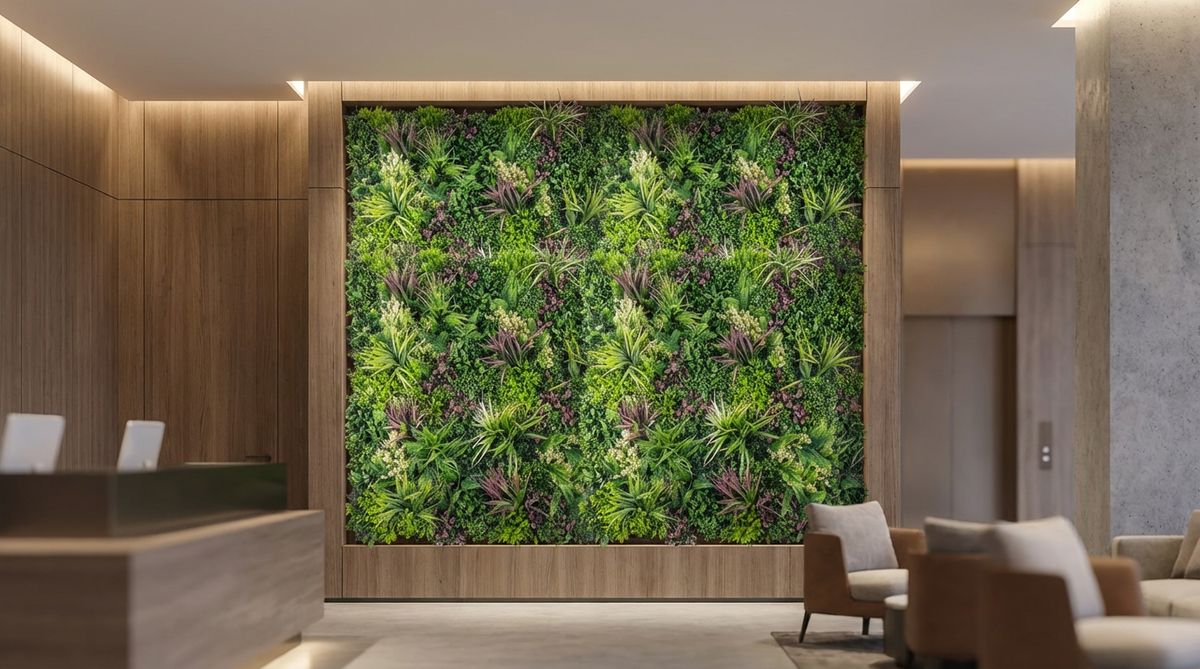
Living wall comparison guide
Choose the right materials, mounting path, and planning route for the environment you are actually building in.
Quick Answers
What most readers need to know first
Can the same panel be used indoors and outdoors?
Outdoor-rated panels can go indoors, but indoor-only panels should not go outside.
Where do the biggest cost differences come from?
Outdoor-rated materials, structural mounting, and weather-rated hardware.
What changes the decision fastest?
Exposure, mounting surface, fire-review context, and visual distance.
Decision Snapshot
The shortest practical summary
Appearance, texture, lighting, and close-up realism.
UV performance, weather-rated mounting, and long-term durability.
Whether the project is truly indoors, truly outdoors, or in a gray zone like a covered patio.
An artificial living wall can go almost anywhere—a restaurant patio, an office lobby, a backyard fence, a bedroom accent wall. But the materials, mounting, and design considerations change significantly depending on whether the wall is inside or outside.
This matters because choosing the wrong materials for the environment shortens the lifespan dramatically. An indoor panel on an outdoor wall in Texas can fade and deteriorate within a year. And an outdoor-rated panel indoors, while it works fine, means you're paying for UV treatment you don't need.
Planning a similar project? See artificial living wall installs →.
This article covers what's different between indoor and outdoor installations so you can specify the right product and approach for your project.
Fast environment comparison
Comparison Matrix
Indoor vs Outdoor Living Walls
Planning a similar project?
Use these next pages while you read
They cover pricing, service details, and the next planning step without making you leave the article blind.
Use this matrix to avoid choosing an indoor visual solution for an outdoor performance problem.
Decision path by environment
Decision Tree
Which path fits your project?
Use the actual environment, not the design mood board, to choose the system.
Real project proof
Project Proof
How this looks in a real project
Use a published Texas install to connect the guide to a real site condition.
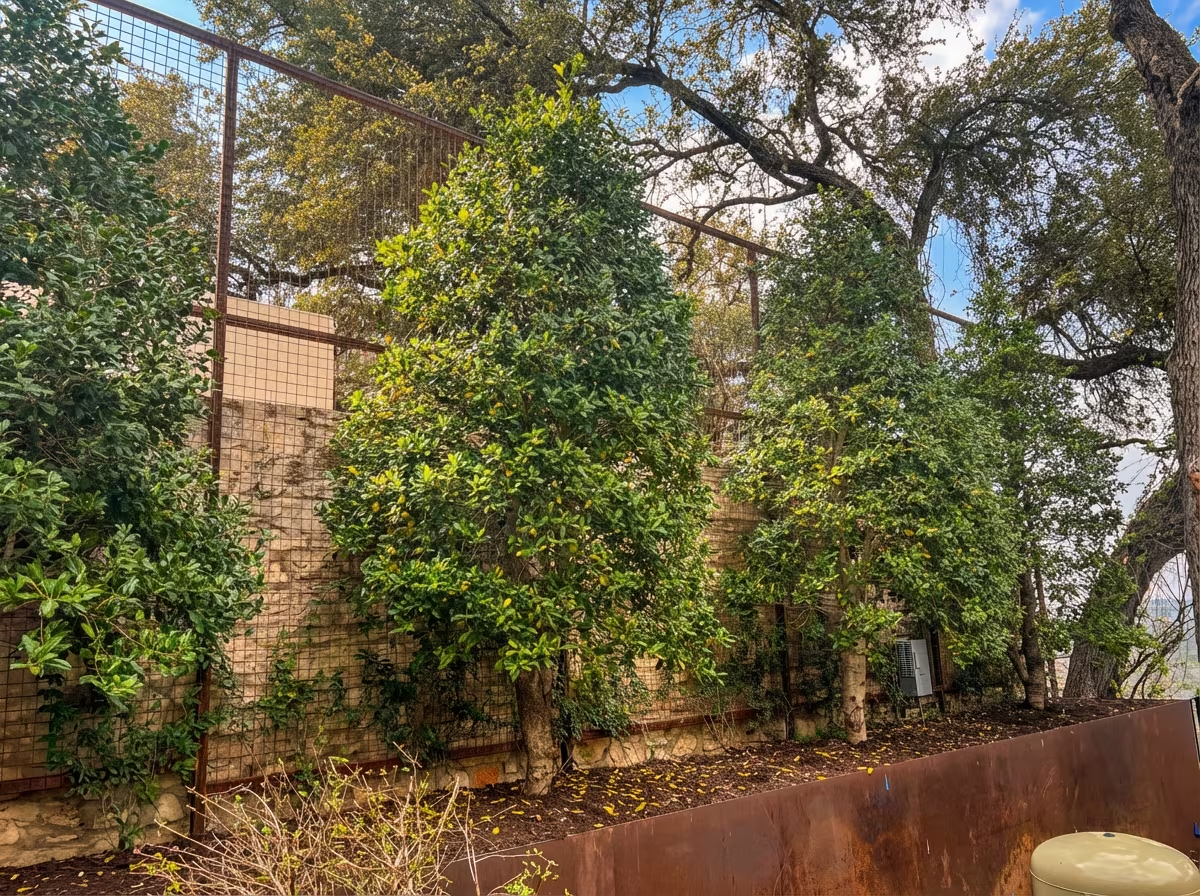 Austin residential privacy wall
A real project showing how an exterior privacy wall changes once structure, exposure, and maintenance reality are taken seriously.
Materials: what changes
Foliage material
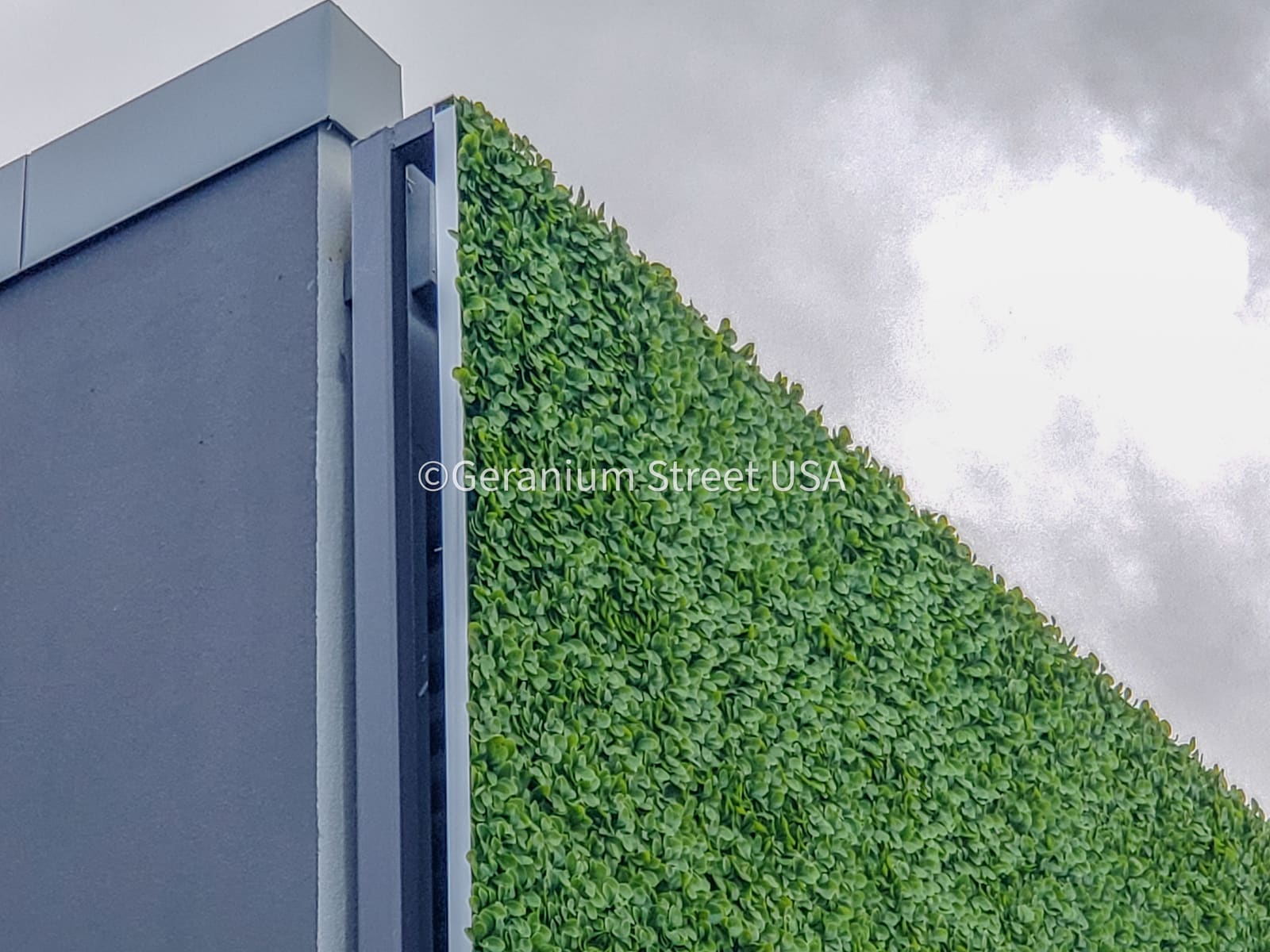
Outdoor: UV-stabilized polyethylene (PE) is the standard. The UV stabilizers protect against the intense solar radiation that Texas outdoor surfaces receive. PE holds color, resists brittleness in heat, and handles moisture from rain and irrigation. Our guide on living wall materials for Texas climate covers the material options in detail.
Indoor: A wider range of materials is available. PE works indoors (it's just not optimized for it), but you can also use silk blends, soft-touch polymers, and mixed-material foliage that feels more realistic. These materials wouldn't survive outdoors but they look and feel better up close—which matters in an indoor setting where people are often within arm's reach.
Backing and frame
Outdoor: The backing grid needs to be rigid enough to resist wind load and sturdy enough to hold up through thermal expansion cycles. Metal frames (aluminum or galvanized steel) are common for outdoor commercial installations. The mounting hardware—screws, anchors, brackets—must be corrosion-resistant (stainless steel or coated).
Indoor: Weight and wind aren't concerns. Lighter backing grids work fine, and standard mounting hardware is acceptable because corrosion isn't a factor. Indoor installations can use adhesive mounting in some cases, which is impractical outdoors because heat and moisture undermine adhesives.
Color and texture
Outdoor: UV-stabilized foliage is formulated for color retention under sun exposure. The color palette tends to be slightly more muted because UV stabilizers can affect how dyes present. Over years of sun exposure, even UV-stabilized panels will shift slightly.
Indoor: Without UV degradation, colors stay truer longer. Indoor panels can use a broader palette—deeper greens, brighter accent colors, more variation between leaf types. The absence of sun bleaching means the wall looks the same on year five as it did on day one.
Fire code: an indoor concern
Fire code requirements apply primarily to indoor installations, particularly in commercial buildings. This is one of the biggest practical differences between indoor and outdoor projects.
Indoor commercial spaces (offices, hotels, restaurants, retail) may require decorative wall materials to meet fire test standards, depending on the building type, occupancy classification, and local jurisdiction. Products tested to NFPA 701 are commonly specified. Some jurisdictions may reference ASTM E84 if the living wall is classified as an interior finish rather than a decorative element.
Indoor residential spaces typically do not require fire-rated materials for decorative elements. However, if you're installing in a condo or apartment building, the building management or HOA may have their own requirements.
Outdoor installations generally face less fire code scrutiny for decorative materials, though covered patios, balconies, and spaces near building egress may still be subject to review depending on local enforcement.
For a detailed breakdown of fire standards, see our NFPA 701 vs ASTM E84 guide.
Mounting: what's different
Outdoor mounting
Outdoor installations must account for:
- Wind load. Panels act as a sail in wind. The mounting system needs to resist sustained wind pressure and gusts. This is especially important in freestanding installations and upper-floor balconies.
- Thermal expansion. Materials expand in heat and contract in cold. Leave small gaps between panels and avoid rigid mounting that doesn't allow for movement.
- Moisture management. An air gap between the panels and the wall surface prevents moisture from getting trapped, which can cause mold on the wall and accelerate degradation of the panel backing.
- Hardware corrosion. Use stainless steel or coated fasteners. Standard steel hardware corrodes quickly in Texas humidity, especially near the coast or around pools.
Common outdoor mounting approaches:
- Furring strips or mounting grid attached to the wall, with panels fastened to the grid. This creates the air gap and provides a consistent mounting plane.
- Aluminum or steel frame (for freestanding or commercial installations) with panels attached to the frame.
- Direct fence attachment using UV-rated zip ties or screws (for residential fence-line installations).
Indoor mounting
Indoor installations are simpler because the environmental stresses are absent:
- No wind load. Standard mounting hardware is sufficient.
- No thermal expansion. Panels can be fitted tightly.
- No moisture concern. Flush mounting to the wall is fine.
- Standard hardware. Drywall anchors, screws, or even adhesive strips work depending on the wall surface and panel weight.
Common indoor mounting approaches:
- Direct to drywall using screws and drywall anchors. For heavier panels, anchor into studs.
- Mounting grid for larger installations where you want a flat, consistent plane across an uneven wall.
- Adhesive mounting for lightweight accent panels on smooth surfaces. This is the easiest installation method but only appropriate for small, light panels.
- Frame-mounted for freestanding room dividers or movable installations.
Lighting: critical indoors, optional outdoors
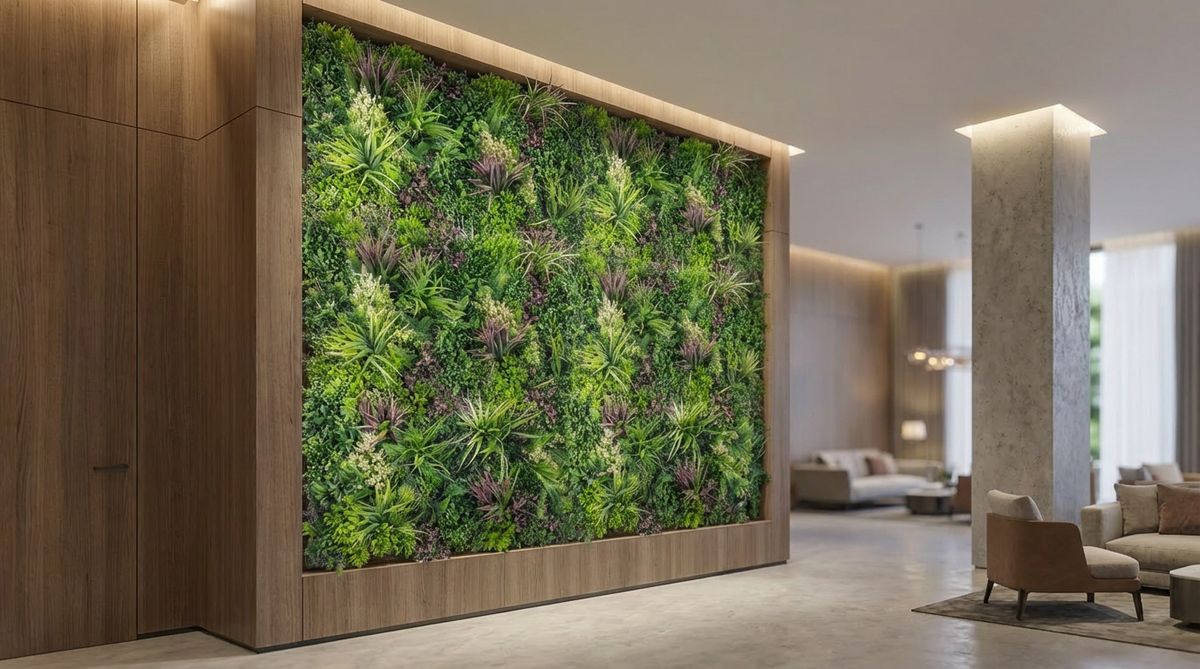
Indoor: Lighting makes or breaks an indoor living wall. Without good lighting, even a beautiful wall looks flat and obviously artificial. With good lighting, it looks alive.
- Warm LED uplighting is the most effective technique. Fixtures at the base of the wall washing upward create depth and shadow in the foliage.
- Wall-wash fixtures mounted above provide even illumination.
- Avoid cool fluorescent overhead lighting. It flattens colors and makes artificial foliage look synthetic.
- Natural daylight (indirect, not direct sun through windows) is ideal for indoor walls. If the wall is near windows with strong sun exposure, consider UV-stabilized panels even for indoor use.
Outdoor: Lighting is optional but adds significantly to the nighttime impact—especially for restaurant patios and entertaining spaces. Uplighting, string lights, and accent spots all work well. Plan lighting before installation so wiring can be routed behind or around the panels.
Design considerations
Indoor design
Indoor living walls tend to be more about visual impact and branding:
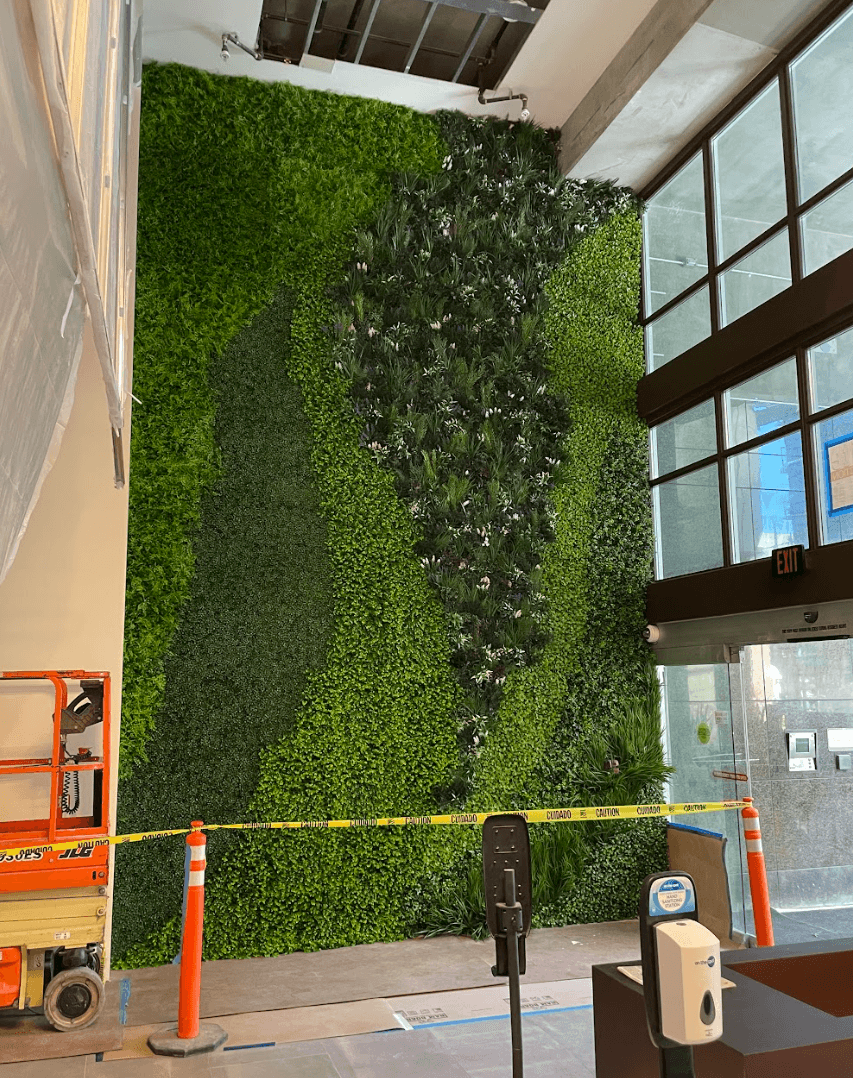
- Feature wall placement — behind a reception desk, in a lobby, behind a bar, or as a photo backdrop
- Mixed foliage density — indoor walls benefit from more variety because viewers are closer and notice detail
- Accent elements — some indoor installations incorporate signage, logos, shelving, or framed art within the living wall
- Coverage area — indoor walls can be any size, from a small accent panel to a full wall. The main constraint is weight on the wall surface.
Outdoor design
Outdoor living walls need to balance aesthetics with environmental durability:
- Scale — outdoor walls are often larger and need to read well from farther away
- Foliage density — needs to be robust enough that individual panels don't look sparse in bright sunlight
- Wall orientation — determines UV exposure and how the foliage colors read at different times of day (see our living walls for Texas summers guide for details on orientation)
- Integration with hardscape — outdoor walls interact with fences, planters, seating, and landscape lighting
Cost differences
Outdoor installations are generally more expensive than comparable indoor ones:
Materials. UV-stabilized outdoor panels cost more than indoor-only versions because of the UV stabilizer additives. The price difference varies by manufacturer but is typically in the range of 10 to 30 percent more for outdoor-rated panels.
Hardware. Stainless steel and coated fasteners cost more than standard hardware. Outdoor mounting grids and frames are built heavier for wind and thermal loads.
Installation labor. Outdoor installations take more time because of the structural requirements, hardware, and air gap detailing. Working outdoors in Texas heat can also slow the pace of work during summer months.
Indoor savings. Indoor installations benefit from lighter mounting systems, standard hardware, and simpler installation. The biggest indoor cost variable is the wall surface—drywall is easy; concrete or brick requires more work.
Related articles
This article is part of our complete guide to artificial living walls in Texas, which covers materials, applications, installation, and maintenance.
You might also find these useful:
For product options, see our living wall page or commercial living wall page.
FAQ
Can I use the same artificial living wall panels indoors and outdoors?
Outdoor-rated panels can be used indoors, but indoor-only panels should not be used outdoors. Outdoor panels include UV stabilization that indoor panels lack. Using indoor panels outdoors results in rapid fading and material degradation. If you are unsure about the rating, check the product spec sheet for UV stabilization.
Do indoor artificial living walls need fire ratings?
For commercial interiors—offices, hotels, restaurants, retail—fire code requirements may apply depending on the building type, occupancy classification, and jurisdiction. Products tested to NFPA 701 are commonly specified for commercial indoor installations. Residential indoor installations typically do not require fire ratings, but check with your local code official if you are unsure.
Are outdoor artificial living walls heavier than indoor ones?
Not necessarily. The weight difference between indoor and outdoor panels is minimal because the foliage density is similar. The main weight difference comes from the mounting system—outdoor installations often use heavier-duty frames and hardware to handle wind load and thermal expansion.
Which costs more—indoor or outdoor artificial living walls?
Outdoor installations typically cost more overall because of UV-stabilized materials, weather-rated hardware, and more involved mounting systems. The panels themselves may be 10 to 30 percent more expensive for outdoor-rated versions, and the installation labor is usually higher because of the structural requirements.
References
- NFPA 701, Standard Methods of Fire Tests for Flame Propagation of Textiles and Films: https://www.nfpa.org/codes-and-standards/nfpa-701-standard-development/701
Truthfulness Check
What To Verify
- Whether the wall is truly indoor, fully outdoor, or a mixed condition.
- Whether the mounting surface can support the chosen system.
- Whether commercial fire-review applies based on occupancy and jurisdiction.
Where to go next
Choose the next page that fits your project
Need a next step?
Need fire-rated options or documentation?
Send the wall size, project type, and timeline. We can tell you when fire-rated foliage or documentation belongs in the scope.
Ready for the next step?
Use the page that fits your project best
Pick the shortest path based on whether you need pricing, a service page, or a local planning page.