Commercial planning guide
Understand which fire standard usually matters, what to verify, and what to ask for before submittals.
Quick Answers
What most readers need to know first
Which standard is most common for decorative greenery?
NFPA 701 is the most common starting point when artificial greenery is treated as a decorative material.
When does ASTM E84 usually enter the conversation?
When the installation may be treated as an interior finish or wall-surface system.
Should you assume one standard covers every project?
No. The right answer depends on classification, occupancy, and AHJ review.
Decision Snapshot
The shortest practical summary
Treat decorative greenery and interior finish questions separately before asking for submittals.
Requesting one test report without confirming how the project will be classified.
Whether the installation is being reviewed as a decorative material or a finish system.
When you start specifying artificial greenery for a commercial project—a hotel lobby, restaurant patio, multifamily amenity space—fire compliance comes up fast. And the first question is usually: which fire standard applies?
The two standards you'll encounter most often are NFPA 701 and ASTM E84. They sound similar (both involve fire and testing), but they measure different things, use different test methods, and apply in different situations. Mixing them up or specifying the wrong one can create problems during inspection.
Planning a similar project? See commercial greenery installs →.
This article explains what each standard actually tests, how they differ, and when each one applies to artificial greenery projects.
NFPA 701: flame propagation of textiles and films
NFPA 701, published by the National Fire Protection Association, is titled "Standard Methods of Fire Tests for Flame Propagation of Textiles and Films." The current edition is 2023.
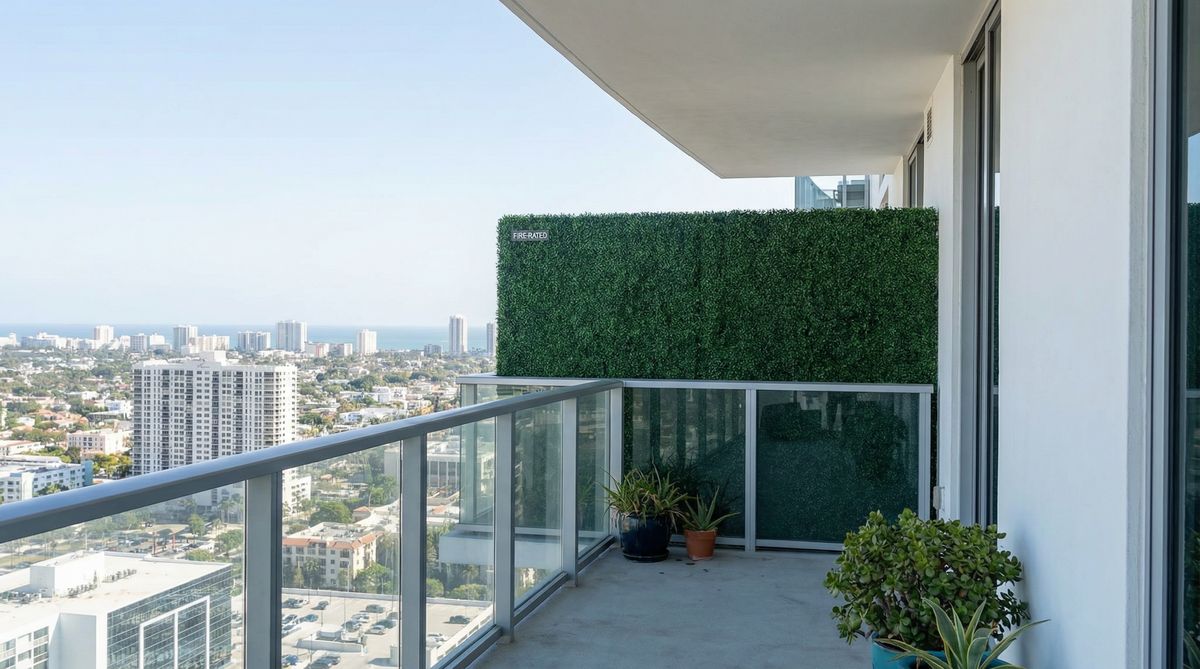
This standard was developed specifically for decorative and functional textiles—curtains, draperies, fabric partitions, banners, and similar materials used in buildings. It's the standard most commonly referenced for artificial greenery in commercial interiors because artificial plants and hedge panels are typically classified as decorative materials.
What it tests
NFPA 701 measures how a material responds to direct flame exposure: does it catch fire, does flame spread beyond the ignition point, and what happens after the flame source is removed?
Method 1 vs Method 2
Method 1 applies to materials with an areal density of 700 g/m² (21 oz/yd²) or less. This covers lighter-weight fabrics: curtains, draperies, single-layer textiles, and similar materials.
The test procedure:
- 10 specimens are tested (5 in each fabric direction if applicable)
- Each specimen is suspended vertically in a combustion chamber
- A flame is applied for 45 seconds
- After the flame is removed, the specimen must meet three pass/fail criteria:
- Average weight loss must not exceed 40%
- Dripping fragments must not continue to burn for an average of more than 2.0 seconds
- Average afterflame time must not exceed 2.0 seconds
Method 2 applies to heavier materials with areal density greater than 700 g/m², as well as coated and laminated fabrics (such as vinyl-backed blackout materials). This method uses a larger test specimen and a more intense exposure.
Most artificial hedge panels and living wall systems are tested under Method 2 because of their weight and density. Our products are tested to NFPA 701 Method 2. The test report will specify which method was used.
What the results mean
A passing result means the product met the quantitative criteria under controlled laboratory conditions. It does not mean the product is fireproof or noncombustible. It means the material resists ignition and limits flame propagation relative to untreated materials.
ASTM E84: surface burning characteristics
Planning a similar project?
Use these next pages while you read
They cover pricing, service details, and the next planning step without making you leave the article blind.
ASTM E84, published by ASTM International (formerly the American Society for Testing and Materials), is titled "Standard Test Method for Surface Burning Characteristics of Building Materials." It's also known as the Steiner Tunnel Test because of the tunnel-shaped test apparatus.
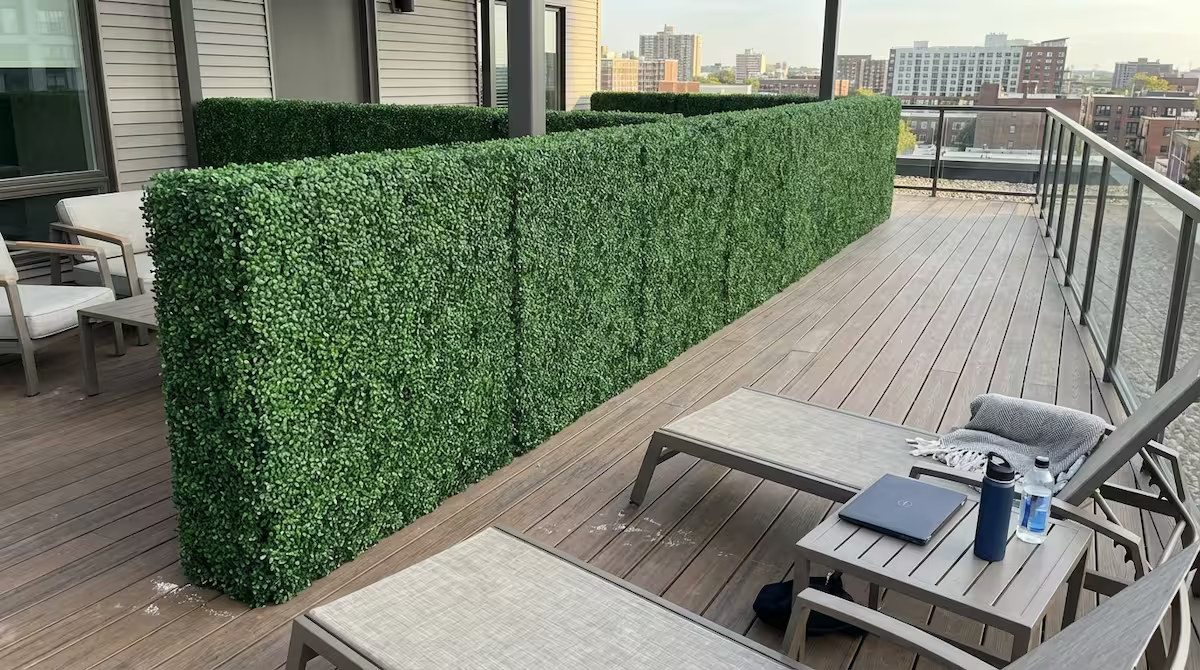
This standard was developed for building materials used as interior finishes—wall coverings, ceiling materials, insulation facings, and other materials applied to building surfaces. It's referenced in the International Building Code (IBC) Chapter 8 for interior finish requirements.
What it tests
ASTM E84 measures two things:
- Flame Spread Index (FSI): How quickly flames travel across the surface of the material.
- Smoke-Developed Index (SDI): How much smoke the material produces while burning.
How the test works
A 24-foot-long specimen is mounted in the ceiling of a tunnel-shaped test chamber. A controlled gas flame is applied at one end, and observers measure how far the flame front travels along the specimen over a 10-minute test period. Smoke density is measured using a photoelectric system.
The results are calibrated against two reference materials:
- Fiber-cement board = 0 (does not propagate flame)
- Red oak = 100 (moderate flame propagation)
Classification system
Based on the test results, materials are classified into three groups per the IBC:
| Class | Flame Spread Index | Smoke-Developed Index |
|---|---|---|
| A | 0–25 | 0–450 |
| B | 26–75 | 0–450 |
| C | 76–200 | 0–450 |
Class A is the most restrictive and indicates the best fire performance. Class C is the minimum acceptable rating for most interior applications.
The IBC specifies which class is required based on the building's occupancy type, sprinkler status, and the location of the material within the building (exit corridors require higher performance than general rooms, for example).
How the two standards differ
Comparison Matrix
NFPA 701 vs ASTM E84
Use this matrix when you need the shortest side-by-side explanation before you ask a manufacturer or AHJ for documentation.
The critical distinction: NFPA 701 tests how a freestanding decorative material responds to direct ignition. ASTM E84 tests how a material behaves as an applied surface finish when flame spreads across it.
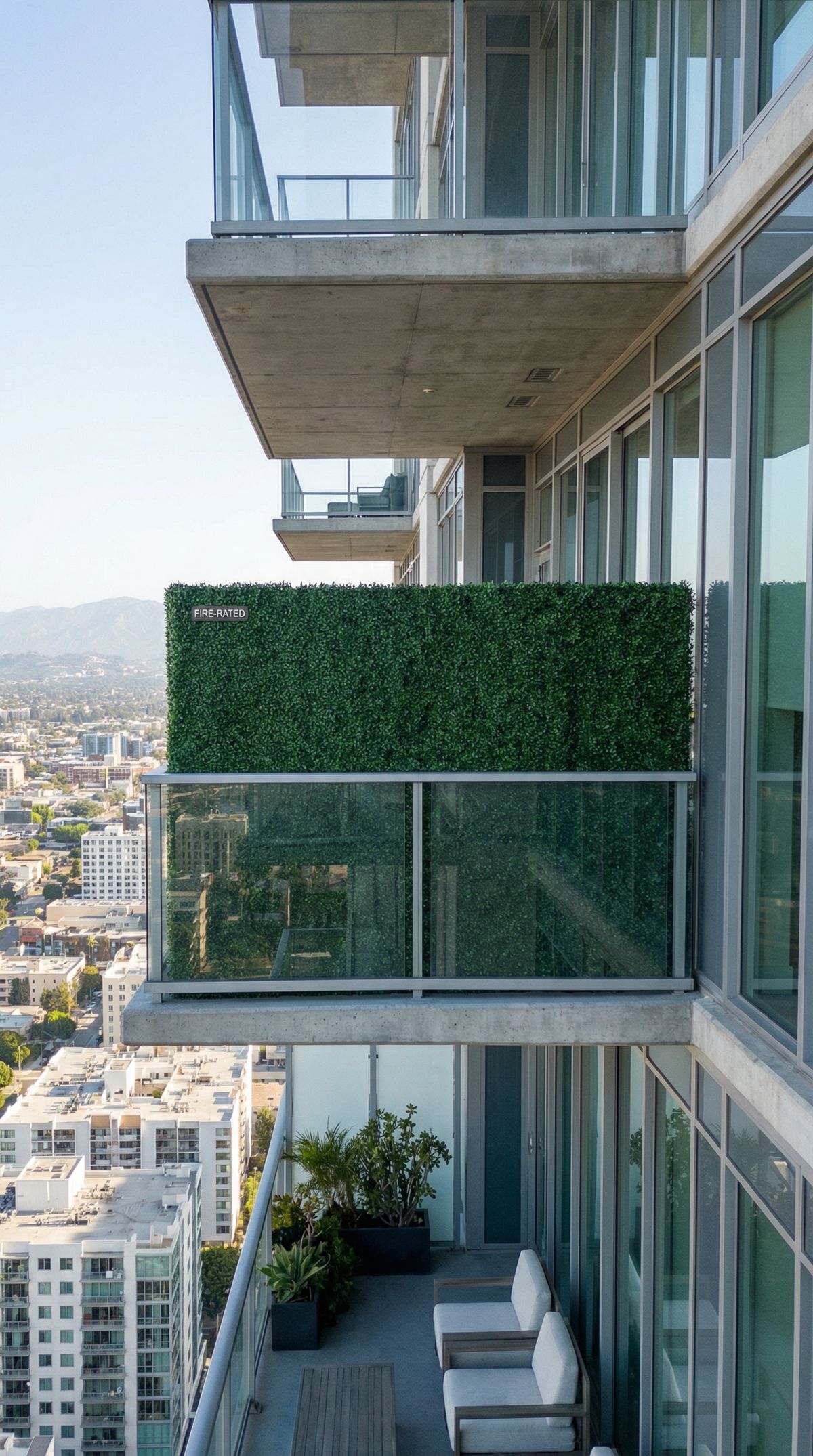
For artificial greenery in most commercial applications, NFPA 701 is the more commonly specified standard because the greenery is treated as a decorative element, not as an interior finish material. However, if the greenery is mounted as a wall covering in a way that the AHJ (Authority Having Jurisdiction) classifies as an interior finish, ASTM E84 may apply.
Which standard does your project need?
The answer depends on three factors:
1. How does the local code classify the installation?
If the artificial greenery is classified as a decorative material (similar to curtains, banners, or wall tapestries), NFPA 701 is typically the applicable standard. If it's classified as an interior finish (similar to a wall covering), ASTM E84 may apply.
2. What does the AHJ require?
The Authority Having Jurisdiction—usually the local fire marshal or building official—has the final say. Requirements vary by city and county across Texas. A quick conversation with the AHJ during the design phase can save weeks of confusion during inspection.
3. What is the building occupancy type?
Assembly occupancies (restaurants, event venues, hotels), high-rise buildings, healthcare facilities, and educational buildings face the most stringent fire requirements. Single-story retail or office spaces may face less scrutiny.
When in doubt, specify both. Some manufacturers test their products to multiple standards, and having documentation for both NFPA 701 and ASTM E84 covers you regardless of how the AHJ classifies the installation.
Other standards you may encounter
California Title 19, Section 1237.1 — The California State Fire Marshal's standard for flame-resistant decorative materials. Some Texas jurisdictions reference this standard, particularly for large-scale installations in assembly occupancies. Products certified to California Title 19 have been tested for flame resistance under California's fire marshal testing program.
UL 723 — Underwriters Laboratories' version of the surface burning test. It's technically equivalent to ASTM E84, and test results are interchangeable. If a product report references UL 723, it provides the same FSI and SDI data as ASTM E84.
What to look for in documentation
When reviewing a fire test report or certificate for artificial greenery, verify:
Checklist
What to verify before submittals
Use this before anyone treats a generic fire report like project-ready documentation.
- The report names the actual product line being installed.
- The test method is stated explicitly.
- The report is current enough for the project team and AHJ.
- The documentation matches how the greenery is being classified.
Related articles
This article is part of our fire-rated artificial greenery guide for Texas commercial properties, which covers fire compliance requirements, documentation, placement, and procurement.
You might also find these useful:
- Firewise artificial hedges for multifamily properties
- Why fire-rated artificial hedges are ideal for Texas high-rises
For fire-rated product options, see our fire-rated artificial hedge page or commercial living wall page.
FAQ
Which fire test standard should I specify for artificial greenery?
For decorative artificial greenery in commercial interiors, NFPA 701 is the most commonly referenced standard. If your project involves artificial greenery being treated as an interior wall finish or ceiling material, ASTM E84 may apply. The correct standard depends on how the greenery is classified under your local building code and the occupancy type. Check with your Authority Having Jurisdiction.
Can a product be certified to both NFPA 701 and ASTM E84?
Yes. Some manufacturers test their products to both standards. However, passing one does not guarantee passing the other because the tests measure different things. If your project requires both, you need documentation for each.
Does a fire rating make artificial greenery fireproof?
No. Fire-rated means the product resists ignition and slows flame propagation under specific test conditions. It does not mean the product cannot burn. All polymer-based artificial greenery is combustible to some degree. Fire ratings indicate how the material behaves relative to untreated materials, not that it is immune to fire.
Do outdoor artificial hedges need fire ratings?
Building codes typically apply fire performance requirements to interior finishes and materials, not exterior landscaping features. However, outdoor installations near building egress paths, covered patios treated as interior space, or near ignition sources may face requirements depending on local enforcement. When in doubt, fire-rated products eliminate the question.
References
- NFPA 701, Standard Methods of Fire Tests for Flame Propagation of Textiles and Films: https://www.nfpa.org/codes-and-standards/nfpa-701-standard-development/701
- ASTM E84, Standard Test Method for Surface Burning Characteristics of Building Materials: https://www.astm.org/e0084-24.html
- International Code Council (IBC): https://www.iccsafe.org/
Truthfulness Check
What To Verify
- How the local jurisdiction is likely to classify the installation.
- Whether the project team needs decorative-material documentation, interior-finish documentation, or both.
- Whether the quoted product is the exact tested product line.
Where to go next
Choose the next page that fits your project
Need a next step?
Need fire-rated options or documentation?
Send the wall size, project type, and timeline. We can tell you when fire-rated foliage or documentation belongs in the scope.
Ready for the next step?
Use the page that fits your project best
Pick the shortest path based on whether you need pricing, a service page, or a local planning page.