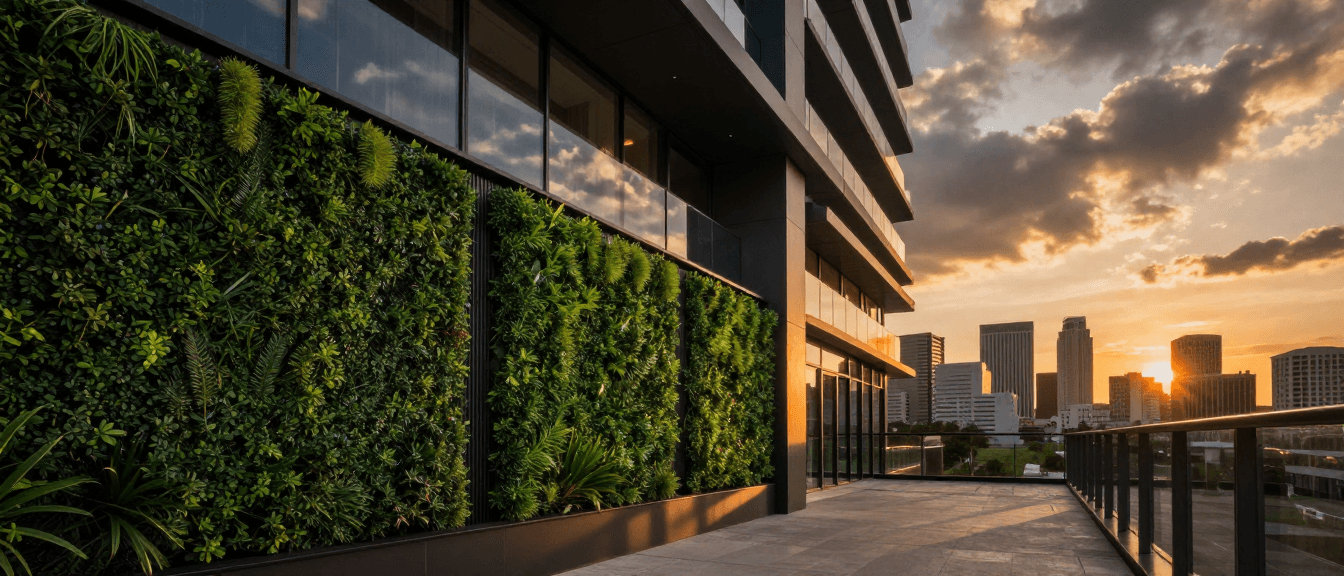
When artificial greenery goes into a commercial project—a hotel lobby, a restaurant patio, a multifamily courtyard, an office building—the conversation shifts. It's no longer just about how it looks. It's about what happens in a fire, what the inspector expects to see, and what paperwork you need in the file.
This guide is for property managers, architects, general contractors, and building owners working on commercial projects in Texas. We'll cover what "fire-rated" actually means when it comes to artificial greenery, which standards apply, where fire compliance is most likely to be required, and how to avoid the procurement and installation mistakes that create problems later.
Planning a similar project? See fire-rated hedge options →.
For project-specific guidance, we've written detailed articles on two common commercial applications: fire-rated artificial hedges for Texas high-rises and firewise artificial hedges for multifamily properties.
What "fire-rated" means for artificial greenery
The term gets used loosely, so let's define it clearly.
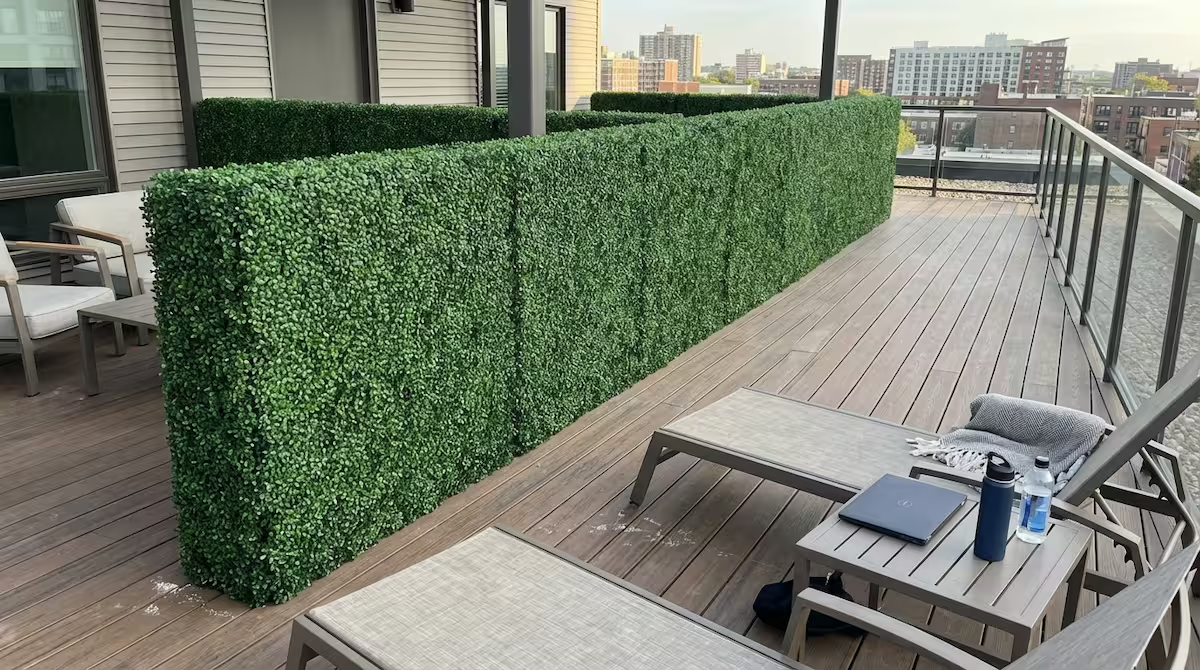
When a vendor says their artificial hedge or living wall panels are "fire-rated," what they should mean is: the product has been tested by an accredited laboratory to a recognized fire test standard, and the results are documented in a test report or certificate that names the specific product.
That's the whole definition. If there's no test report, no lab name, and no standard referenced, the claim doesn't mean much.
The standards you'll encounter
NFPA 701 — This is the standard most commonly referenced for artificial greenery in commercial settings. Published by the National Fire Protection Association, NFPA 701 establishes test methods for flame propagation of textiles and films. It includes two methods:
- Method 1 applies to individual fabrics and small-scale items.
- Method 2 applies to larger decorative assemblies—this is usually the relevant method for artificial greenery panels and living wall systems.
The test exposes the material to a controlled flame for a set duration and measures how the material responds—whether it self-extinguishes, how far flames propagate, and the characteristics of any dripping or melting.
ASTM E84 — Also called the "tunnel test," this standard measures flame spread and smoke development of materials when exposed to fire. It assigns a Flame Spread Index and a Smoke Developed Index. ASTM E84 is referenced in building codes (particularly the International Building Code, which Texas largely adopts) for interior finish materials. Some jurisdictions may apply it to artificial greenery installations depending on how they classify the product.
California Title 19, Section 1237 — California's state fire marshal standard for flame-resistant decorative materials. Some Texas jurisdictions reference this, particularly for interior commercial applications. If you see a product certified to California Title 19, it's a relevant data point.
What these standards do and don't tell you
A passing test result means the product resisted flame propagation under the specific conditions of that test. It does not mean the product is fireproof, noncombustible, or safe under all fire scenarios.
Important distinctions:
- Fire-rated / fire-retardant / flame-resistant = the product resists ignition and slows flame spread under test conditions.
- Fireproof = implies the material cannot burn. No decorative artificial greenery meets this definition. Avoid vendors who use the word "fireproof."
- Noncombustible = the material does not contribute fuel to a fire. Most artificial greenery is polymer-based and is technically combustible, even when fire-retardant treated. It can melt, deform, and produce smoke.
The practical takeaway: fire-rated artificial greenery is designed to resist ignition and slow flame spread, not to be indestructible in a fire. That's a meaningful safety improvement over untreated materials, but it's important to set realistic expectations.
Where fire compliance applies in Texas commercial projects
Planning a similar project?
Use these next pages while you read
They cover pricing, service details, and the next planning step without making you leave the article blind.
Texas adopts the International Building Code (IBC) and International Fire Code (IFC) as its base codes, with local amendments by jurisdiction. Fire code requirements for decorative materials and wall coverings vary depending on:
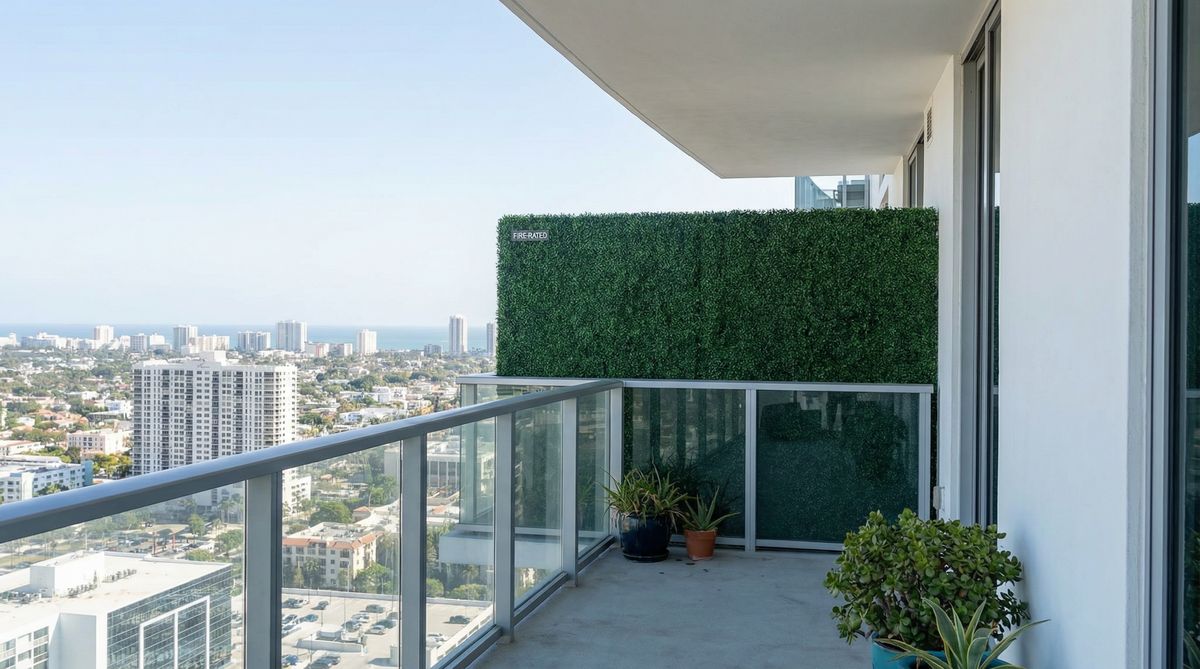
- Building occupancy type. Assembly occupancies (restaurants, event spaces, hotels), high-rise buildings, healthcare facilities, and educational buildings face the most scrutiny.
- Location within the building. Interior installations—especially along egress paths, in lobbies, and in assembly areas—are more likely to require documentation than fully exterior installations.
- Local enforcement. Texas cities enforce codes through their local Authority Having Jurisdiction (AHJ), typically the fire marshal or building inspector. What triggers a requirement in Houston may not in a smaller jurisdiction, and vice versa.
Where you'll most likely need fire-rated products
Interior common areas in multifamily buildings. Lobbies, hallways, amenity spaces, leasing offices. If the artificial greenery is functioning as a wall covering or decorative element in an occupied interior space, the local AHJ may require documentation. Our guide on firewise artificial hedges for multifamily properties covers the procurement and placement details for property managers.
High-rise balconies and common areas. High-rise fire codes are strict about combustible materials on balconies and in common areas because fire spread between floors is a primary concern. Many high-rise HOAs and management companies require fire-rated materials as a standard specification. See our detailed guide on fire-rated artificial hedges for Texas high-rises.
Restaurant and hospitality interiors. Restaurants, bars, hotels, and event spaces fall under assembly occupancy classifications that require interior finishes and decorative materials to meet fire standards. The kitchen proximity adds another layer—artificial greenery near cooking equipment, grills, or heaters faces practical fire risk beyond code compliance.
Covered patios and semi-outdoor spaces. This is where requirements get gray. A fully open-air patio may face fewer requirements than a covered patio that's treated as interior space for code purposes. If in doubt, specify fire-rated materials. It eliminates the ambiguity.
Near egress paths. Any decorative material installed near building exits, stairwells, or evacuation routes is likely to receive scrutiny. Fire codes prioritize keeping egress paths clear and free from materials that could contribute to flame spread.
Where fire-rated products may not be required but are still smart
Exterior fence-line hedges on commercial properties. A hedge screen along a parking lot perimeter or property boundary is less likely to trigger fire code requirements than an interior installation. But proximity to dumpsters, grills, smoking areas, or mechanical equipment introduces practical fire risk regardless of code. Fire-rated products in these spots are a risk management decision, not just a compliance decision.
The documentation that matters
If you're specifying, procuring, or approving artificial greenery for a commercial project, collect this documentation early and keep it in the project file:
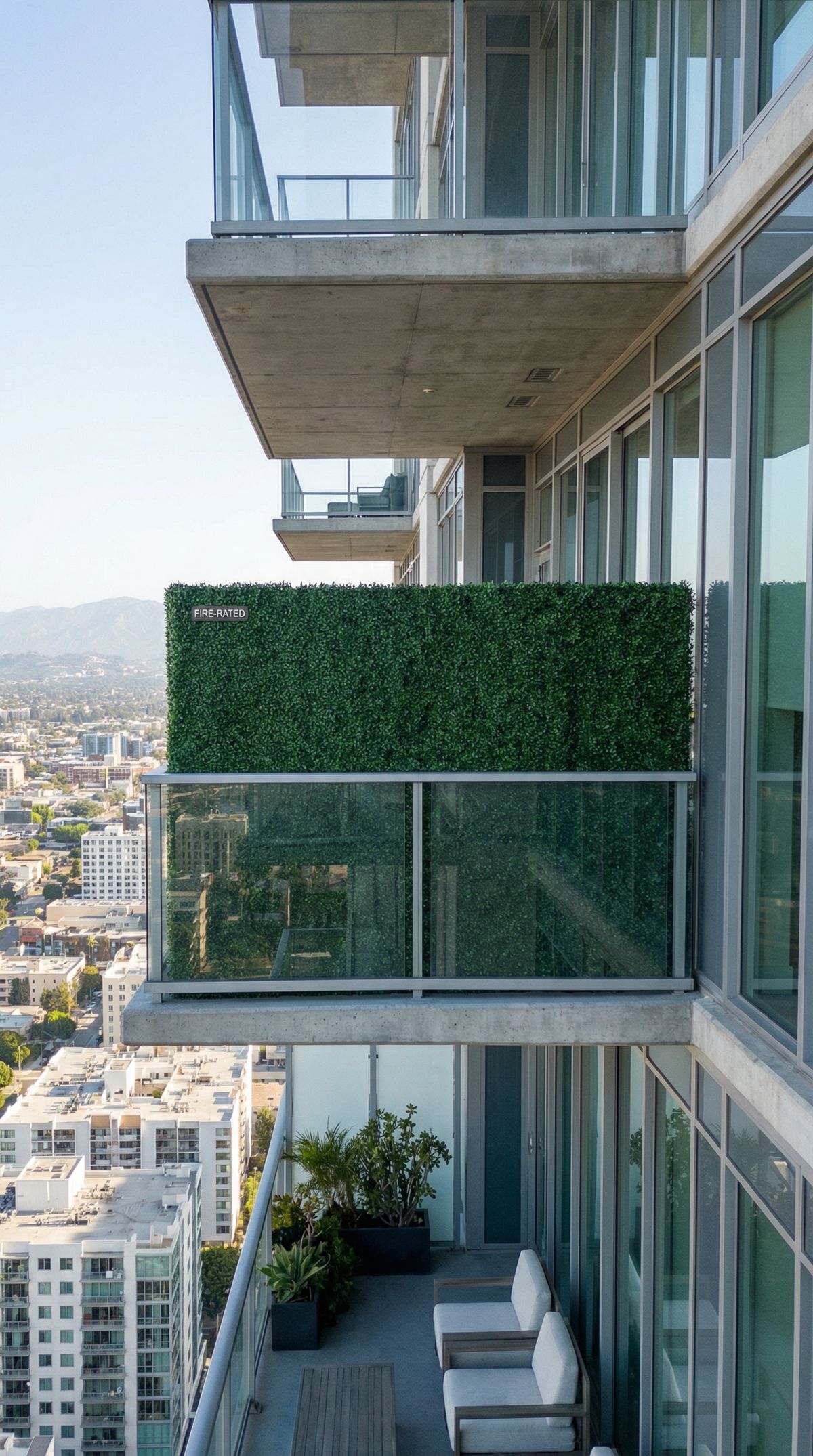
1. Test report or certificate naming the specific product. The document should identify the product by name, model, and ideally manufacturer. A generic report for "artificial foliage sample" is weak. The report should name what you're installing.
2. The test standard and method. NFPA 701 Method 1 or Method 2, ASTM E84, or another recognized standard. The report should clearly state which standard was used and the result.
3. The testing laboratory. The lab should be accredited—look for accreditation by a recognized body (NVLAP, A2LA, or similar). An unaccredited "lab" report carries less weight with inspectors and insurers.
4. Product specification sheet. Material composition, dimensions, weight, intended use (indoor/outdoor), UV treatment details, and cleaning instructions.
5. Installation instructions. How the product is designed to be installed—fastener types, substrate requirements, mounting method. This matters because the fire test was performed on a specific product configuration. If the installation deviates significantly from the tested configuration, the test results may not apply.
6. Fire-retardant treatment details (if applicable). Some products have fire-retardant properties built into the base material during manufacturing. Others rely on a topical treatment applied to the surface. If it's a topical treatment, document:
- Whether it's factory-applied or field-applied
- The recommended reapplication schedule (if any)
- What conditions can degrade it (UV exposure, pressure washing, certain cleaning chemicals)
Keep all of this in a shared folder. Staff changes, inspections, insurance audits, and property sales all create moments when someone needs to find this paperwork.
Fire-rated vs. topical treatment: an important distinction
There are two ways an artificial greenery product achieves fire performance:
Inherent fire resistance (built-in). The fire-retardant chemistry is integrated into the polymer during manufacturing. The material itself has fire-resistant properties that don't depend on a surface coating. This approach is generally more durable because the fire performance doesn't degrade with cleaning, UV exposure, or weathering.
Topical fire-retardant treatment (applied). A chemical solution is sprayed or dipped onto the finished product. This can be effective, but the treatment can wear off over time—particularly with UV exposure, rain, harsh cleaning, or heavy use. Some products require periodic reapplication.
For commercial projects where long-term compliance matters, products with inherent fire resistance are the lower-risk choice. If the product relies on a topical treatment, build reapplication into your maintenance plan and document the schedule.
Placement: where you put it matters as much as what you buy
Even with documented fire-rated products, placement drives a significant portion of the real-world fire risk. The principle is straightforward: don't put combustible decorative materials next to likely ignition sources.
On commercial properties, the common ignition-risk zones include:
- Grill areas and outdoor kitchens (restaurant patios, hotel pool decks, multifamily courtyards)
- Trash enclosures and dumpster areas where cardboard and waste accumulate
- Mechanical equipment with hot surfaces or fuel sources
- Loading docks and service corridors where flammable materials stack up
- Smoking areas (designated or informal)
- Electrical panels and transformers
If artificial greenery is being used to screen one of these areas, treat the placement as a constraint. Maintain separation distance, use noncombustible backing where appropriate, and consider whether the screening function can be achieved with the greenery set back from the ignition source.
Product options for commercial projects
We offer several product lines suited for commercial fire compliance:
- Fire-rated artificial hedge panels — NFPA 701 tested options for fences, screens, and balcony applications
- Commercial living wall systems — Mixed foliage panels designed for lobbies, restaurants, and high-visibility commercial spaces
- Vallum FRX architectural wall system — Our premium modular system for large-scale commercial and architectural installations
Each product page includes material specifications. For fire test documentation specific to a product you're considering, contact us directly.
Working with inspectors and the AHJ
A few practical notes for navigating the approval process:
Submit early. Don't wait until the greenery is installed to find out whether the inspector expects documentation. Provide the product spec sheet and fire test report during the submittal phase, alongside other finish and material submittals.
Know your AHJ. The Authority Having Jurisdiction is typically the local fire marshal or building official. Requirements and enforcement vary by city and county across Texas. What passes in one jurisdiction may get flagged in another. A quick phone call or email to the AHJ before procurement can save significant time.
Keep it simple. Inspectors want to see that the product is documented, that the documentation matches what's installed, and that the installation makes sense from a safety perspective. A clean submittal package—test report, product spec, installation plan—goes a long way.
Don't mix and match undocumented components. If the fire test covers a specific panel, mounting it with a different backing, adhesive, or frame that wasn't part of the test can undermine the documentation. Keep the assembly consistent with what was tested.
Cross-reference: artificial hedges and living walls
This guide focuses on the fire compliance side. For broader guidance on artificial greenery products, materials, and installation in Texas, see our companion guides:
- The complete guide to artificial hedges in Texas — Types, climate performance, costs, HOA, and installation
- The complete guide to artificial living walls in Texas — Materials, indoor vs outdoor, residential and commercial applications
And for detailed commercial applications:
- Fire-rated artificial hedges for Texas high-rises
- Firewise artificial hedges for multifamily properties
FAQ
Is fire-rated artificial greenery required for all commercial buildings in Texas?
Not universally. Requirements depend on the building type, occupancy classification, where the greenery is installed, and local code enforcement. Interior installations in assembly and high-occupancy buildings are most likely to require documentation. The best approach is to check with your local Authority Having Jurisdiction (AHJ) early in the project.
What is NFPA 701?
NFPA 701 is a standard published by the National Fire Protection Association that establishes test methods for measuring the flame propagation of textiles and films. It includes two methods: Method 1 for individual fabrics and small-scale items, and Method 2 for larger assemblies. It is commonly referenced for decorative materials in commercial spaces, including artificial greenery.
What is the difference between fire-rated and fireproof?
Fire-rated means the product has been tested and meets a specific standard for flame propagation resistance—it resists ignition and slows flame spread under test conditions. Fireproof implies the material cannot burn at all. No decorative artificial greenery is fireproof. The accurate terms are fire-rated, fire-retardant, or flame-resistant.
Can fire-retardant treatments wear off over time?
If the fire resistance comes from a topical chemical treatment applied after manufacturing, it can degrade due to UV exposure, weathering, and cleaning. Products with fire-retardant properties built into the base material during manufacturing are generally more durable. Always ask whether the fire performance is inherent or applied, and whether reapplication is recommended.
Do outdoor artificial hedges on commercial properties need fire ratings?
It depends on placement and jurisdiction. Outdoor installations near building egress paths, balconies, covered patios, or close to ignition sources may be subject to fire code review. Fully exterior installations away from buildings often face less scrutiny, but local enforcement varies. When in doubt, specify fire-rated products—it eliminates the question.
What documentation should I keep on file?
Keep the fire test report or certificate that names the exact product installed, the test standard and method used, the product specification sheet, installation details, and any maintenance or cleaning guidance that could affect the fire rating. Store these in a shared project folder that survives staff turnover.
Need fire-rated product specifications for a commercial project? Contact us for documentation and quotes.
References
- NFPA 701, Standard Methods of Fire Tests for Flame Propagation of Textiles and Films: https://www.nfpa.org/codes-and-standards/nfpa-701-standard-development/701
- ASTM E84, Standard Test Method for Surface Burning Characteristics of Building Materials: https://www.astm.org/e0084-24.html
- International Code Council (IBC/IFC adopted by Texas): https://www.iccsafe.org/
Need a next step?
Need fire-rated options or documentation?
Send the wall size, project type, and timeline. We can tell you when fire-rated foliage or documentation belongs in the scope.
Ready for the next step?
Use the page that fits your project best
Pick the shortest path based on whether you need pricing, a service page, or a local planning page.