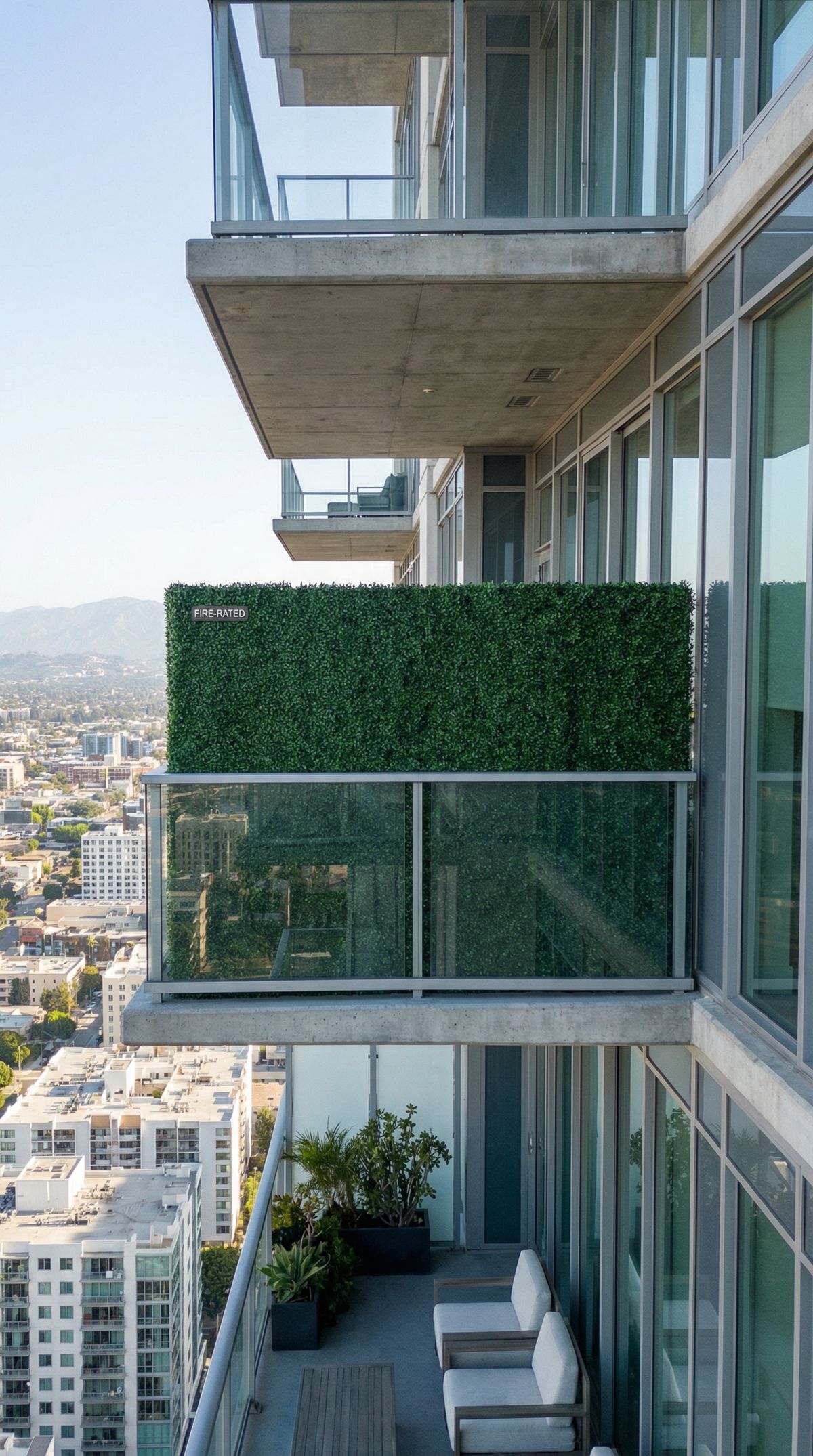
Apartment and condo balconies in Texas are usually the smallest outdoor space a resident has—and often the least private. Between close-together buildings, glass railings, and neighbors above and below, the balcony can feel exposed.
Artificial hedge panels are one of the most practical ways to add privacy. They attach to the railing or balcony wall, block sightlines, and look better than fabric screens or bamboo roll-ups. But apartment balconies—especially on high-rise buildings—come with rules and fire safety requirements that don't apply to a backyard fence.
Planning a similar project? See fire-rated hedge options →.
This guide covers what you need to know: the fire code factor, wind considerations, getting management approval, and choosing the right product.
The fire code factor on balconies
Balcony fire safety is a serious subject in multistory buildings, and it's the first thing to understand before shopping for balcony privacy screens.
Why balconies are different
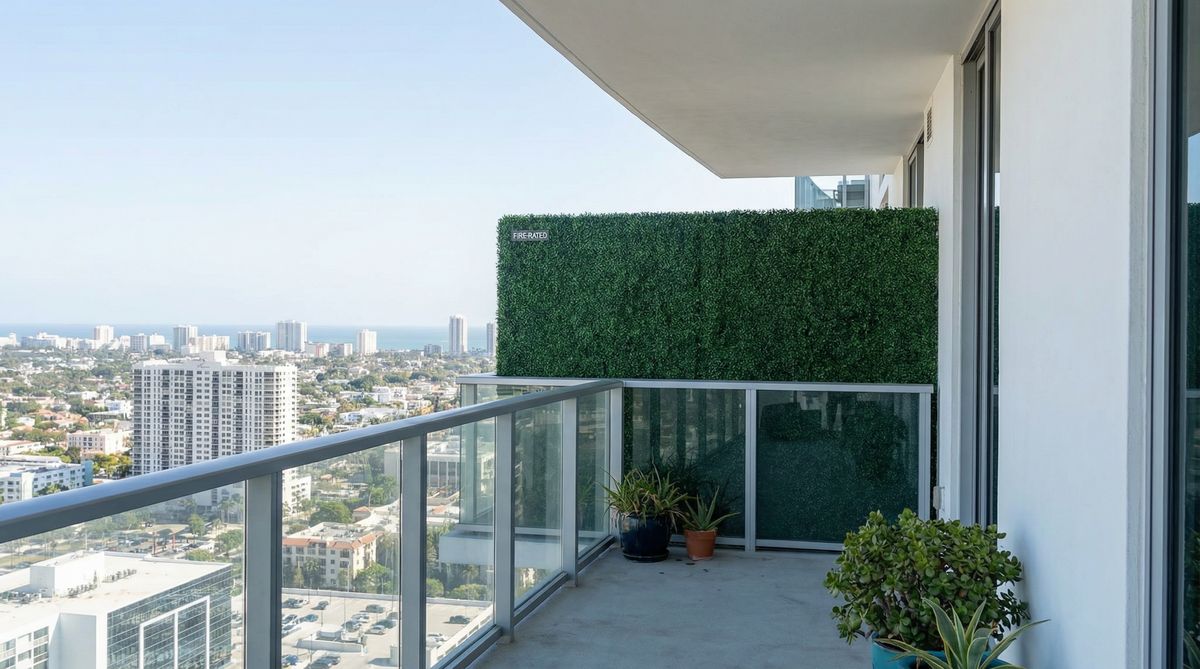
When a fire starts on a balcony—from a grill, a cigarette, a candle, or an electrical fault—the flames can spread upward to the balcony above. This is called vertical fire spread, and it's one of the primary concerns in multistory building fire safety.
The risk increases with combustible materials on the balcony: furniture, plants, decorations, storage, and screening materials all add fuel. High-rise buildings (defined by the IBC as buildings with an occupied floor more than 75 feet above fire department vehicle access) face the strictest requirements because of the difficulty of firefighting at height.
What the codes say
The IBC and IFC address combustible materials on balconies:
- Many jurisdictions restrict or prohibit open-flame devices (grills, fire pits) on balconies above a certain height
- Combustible storage on balconies may be restricted
- Decorative materials on balconies, including artificial greenery, may be subject to fire code requirements depending on the jurisdiction and building type
The specifics vary by city. Some Texas jurisdictions have explicit rules about balcony materials; others rely on general fire code provisions and the judgment of the local fire marshal.
Why fire-rated hedges solve the problem
Fire-rated artificial hedge panels—tested to NFPA 701 Method 2—resist ignition and slow flame propagation. They don't eliminate fire risk entirely (no decorative material does), but they significantly reduce the contribution to a balcony fire compared to untreated materials.
For building managers and residents alike, fire-rated products provide:
- Code compliance — documentation that satisfies the AHJ
- Insurance defensibility — proof that reasonable precautions were taken
- Management approval — buildings are more likely to approve materials with fire documentation
For the technical details on fire standards, see our NFPA 701 vs ASTM E84 guide.
Wind: the balcony-specific challenge
Planning a similar project?
Use these next pages while you read
They cover pricing, service details, and the next planning step without making you leave the article blind.
Ground-level fence installations don't worry much about wind. Balconies on upper floors are a different story. Wind speed increases with height, and balconies can create turbulence patterns that amplify gusts.
Why it matters
An artificial hedge panel on a balcony railing acts like a sail. In high wind, a panel that isn't securely fastened can:
- Rip free and become a falling object—a serious safety hazard on a high-rise
- Flap and stress the railing or mounting points
- Create noise that disturbs neighbors
How to secure panels
Mechanical fasteners to the railing. Screws, bolts, or heavy-duty clamps that attach the panel directly to the railing structure. This is the most secure method.
UV-rated zip ties (as supplemental attachment). Zip ties alone may not be sufficient for high-wind balconies, but they work as secondary attachment in addition to mechanical fasteners.
Never rely on friction, weight, or leaning. A panel leaned against a railing with no fasteners will become a projectile in a storm.
Check with building management. Some buildings have rules about drilling into railings or attaching items to the balcony structure. Get approval for the mounting method, not just the product.
Panel selection for wind
Panels with open or semi-porous backing allow some wind to pass through rather than catching it all as a solid surface. This reduces the wind load on the mounting points. Solid-backed panels create more wind resistance and require stronger attachment.
Getting building approval
Almost every apartment building and condominium has rules about what residents can place on balconies. These rules typically cover:
- Aesthetic standards — what's visible from outside the building must meet community appearance guidelines
- Safety requirements — items must be securely mounted and not create hazards
- Fire safety — combustible materials may be restricted or require documentation
- Weight limits — balconies have structural load limits
- Maintenance — items must be maintained in good condition
What to submit
When requesting approval from building management or the HOA board:
- Product specification sheet showing the material (polyethylene, UV-stabilized), dimensions, and weight
- Fire test documentation (NFPA 701 Method 2 test report or certificate) — this is the piece that typically wins approval in buildings that would otherwise say no
- Installation plan describing how the panels will be mounted and confirming they won't damage the railing or balcony structure
- Photos of completed installations showing what the finished product looks like on a similar balcony
- A physical sample if possible — letting the review committee see and touch the product removes objections about "fake-looking" greenery
The fire documentation is often the deciding factor. Buildings that restrict balcony decorations because of fire concerns are much more likely to approve a product with NFPA 701 documentation than one without it.
For a detailed guide to the HOA approval process, including your rights under Texas law, see our HOA approval guide.
Common balcony configurations
Railing-mounted privacy screen
The most common setup: panels attached to the inside of the balcony railing to block sightlines from adjacent balconies and the ground. This provides privacy without reducing the footprint of the balcony.
Works best with:
- Metal or glass railings that provide solid attachment points
- Panels sized to fit the railing height (typically 36 to 42 inches for residential balconies)
Balcony wall accent
For balconies with a solid wall on one or more sides, mounting panels to the wall creates a green backdrop for the seating area. This is more about aesthetics than privacy, but it transforms a concrete or stucco wall into a more inviting space.
Corner privacy screen
If the privacy issue is from a specific angle—a neighboring balcony to one side, for example—a panel on just one section of the railing addresses the sightline without screening the entire perimeter.
Full perimeter screening
Covering all railing sections with hedge panels provides maximum privacy but also maximum wind resistance. For full perimeter installations on upper floors, use the most secure mounting method available and verify wind rating with the manufacturer.
Choosing the right product for balconies
The ideal balcony hedge panel has:
- Fire rating (NFPA 701 Method 2) — for code compliance and management approval
- UV stabilization — balconies get direct sun exposure, often on south or west orientations
- Lightweight construction — balconies have load limits, and lighter panels are easier to handle at height
- Semi-porous backing — reduces wind load compared to solid panels
- Interlocking edges — creates a seamless look across multiple panels
- Realistic appearance — visible from street level, the panels represent the building's appearance
Related articles
This article is part of our fire-rated artificial greenery guide for Texas commercial properties, which covers standards, documentation, and procurement.
You might also find these useful:
- Why fire-rated artificial hedges are ideal for Texas high-rises
- How to get HOA approval for artificial hedges in Texas
For fire-rated balcony products, see our fire-rated artificial hedge page or contact us for a quote.
FAQ
Can I put artificial hedges on my apartment balcony?
In most cases, yes—but you need approval from building management or the HOA, and the product may need to meet fire code requirements. High-rise buildings are particularly strict about combustible materials on balconies because of the risk of fire spread between floors. Check with your building management before purchasing or installing anything.
Why do balcony hedges need to be fire-rated?
Balconies are exterior extensions of the building, and fire on a balcony can spread upward to balconies above via radiant heat and flame impingement. High-rise fire codes restrict combustible materials on balconies to reduce this risk. Fire-rated artificial hedges resist ignition and slow flame spread, which is why many buildings require them.
Will artificial hedges blow off a balcony in wind?
Wind is a real concern on upper-floor balconies. Panels must be securely mounted to the railing or balcony wall—not leaned against the railing or held in place by weight alone. Use mechanical fasteners rated for the expected wind loads. Loose panels become projectiles in high wind and create a safety hazard.
Do I need my HOA or building management to approve balcony hedges?
Almost always. Most apartment buildings and condominiums have rules governing what residents can place on balconies. These rules exist for safety, aesthetic consistency, and liability reasons. Submit your request with product specifications and fire test documentation before purchasing.
References
- International Code Council (IBC/IFC): https://www.iccsafe.org/
- NFPA 701: https://www.nfpa.org/codes-and-standards/nfpa-701-standard-development/701
Need a next step?
Need fire-rated options or documentation?
Send the wall size, project type, and timeline. We can tell you when fire-rated foliage or documentation belongs in the scope.
Ready for the next step?
Use the page that fits your project best
Pick the shortest path based on whether you need pricing, a service page, or a local planning page.