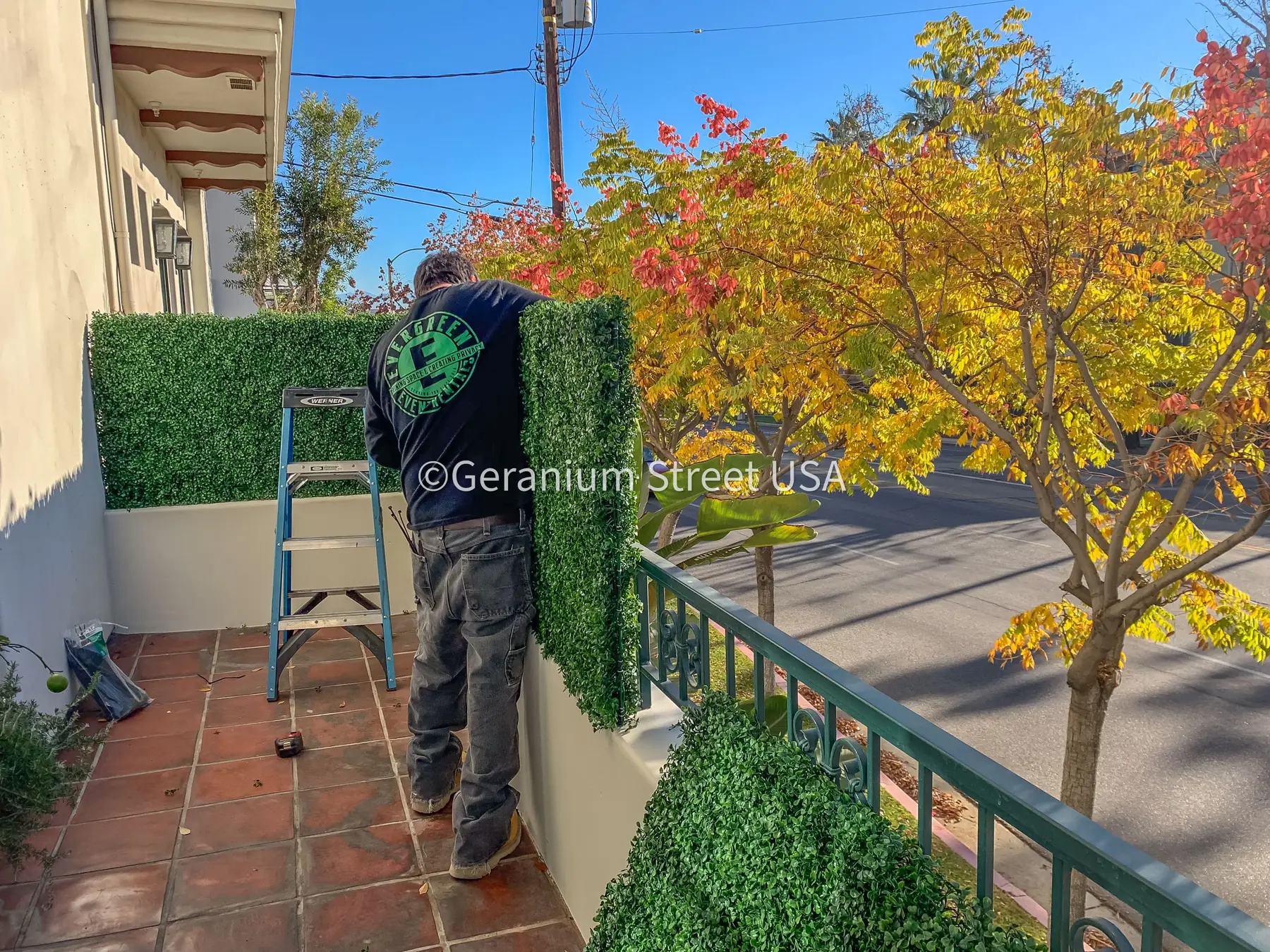
If you've lived through a few Texas summers, you already know the cycle: plant something green, water it constantly, watch it struggle through July and August, then deal with whatever the next freeze or drought finishes off. It's why more homeowners and property managers across the state are switching to artificial hedges—and why the products available now look nothing like the plastic plants you might remember.
This guide covers the practical side of artificial hedges in Texas: what types exist, how they hold up in our climate, what they actually cost over time, how to deal with HOAs, and what matters during installation. If you want the short version on any subtopic, we've written deeper articles on each one (linked throughout).
Planning a similar project? See pool privacy screens →.
What artificial hedges actually are (and what's changed)
An artificial hedge is a panel or roll of synthetic foliage designed to look like a natural hedge. The panels mount to fences, walls, frames, or freestanding structures to create an instant green barrier.
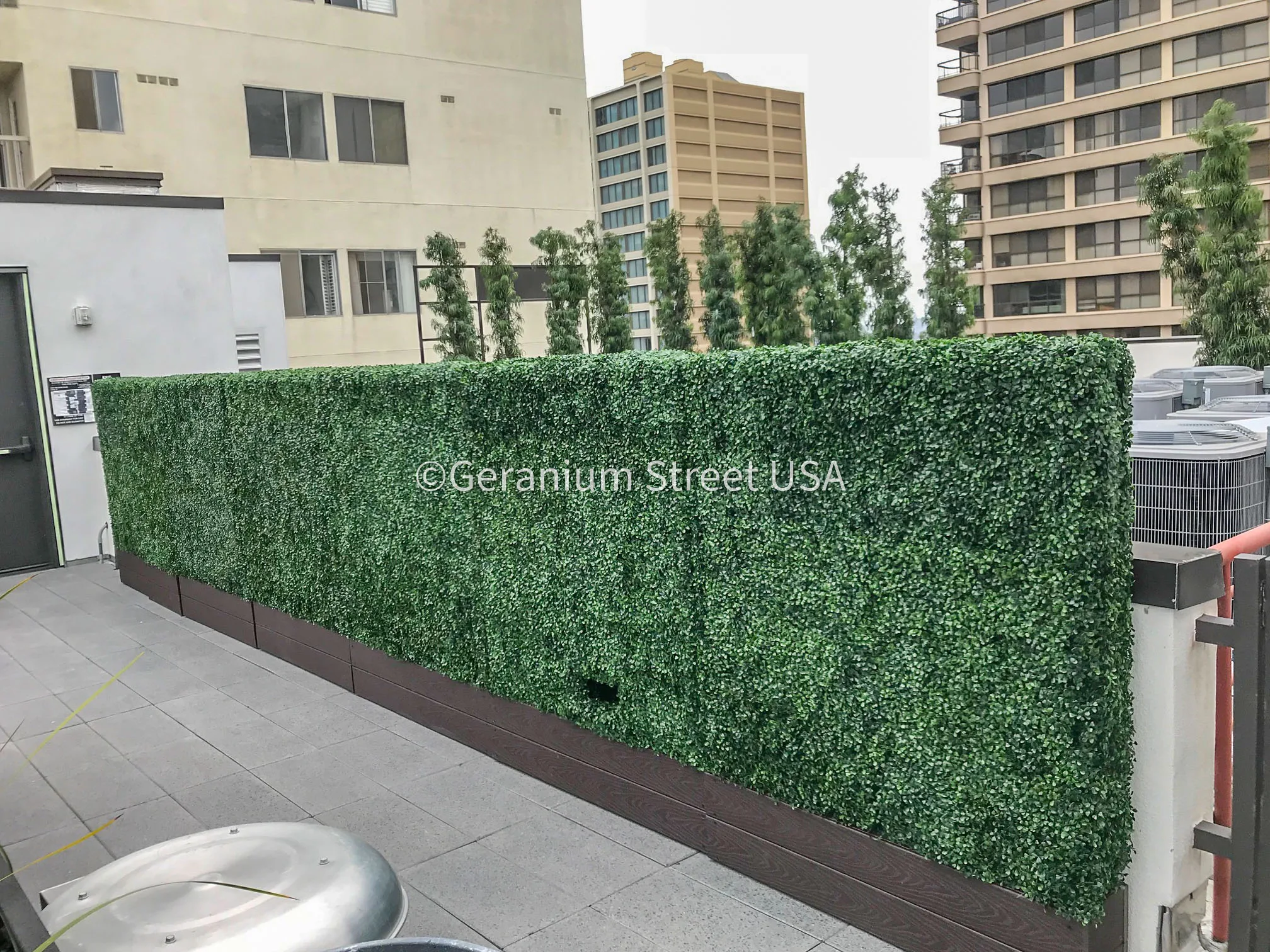
The technology has evolved significantly. Today's commercial-grade panels are made primarily from polyethylene (PE), the same material family used in outdoor furniture and playground equipment. The leaves are molded from real plant specimens, with multiple color shades, varied leaf sizes, and randomized placement to avoid the "copy-paste" look that gave older artificial plants a bad reputation.
The most important feature for Texas applications is UV stabilization—additives blended into the material during manufacturing that slow the breakdown caused by ultraviolet radiation. Without UV stabilization, any polymer will fade and become brittle in direct sun. With it, the material holds its color and flexibility for years.
Types of artificial hedges
Planning a similar project?
Use these next pages while you read
They cover pricing, service details, and the next planning step without making you leave the article blind.
Not all panels are the same. The main styles you'll see in the Texas market:
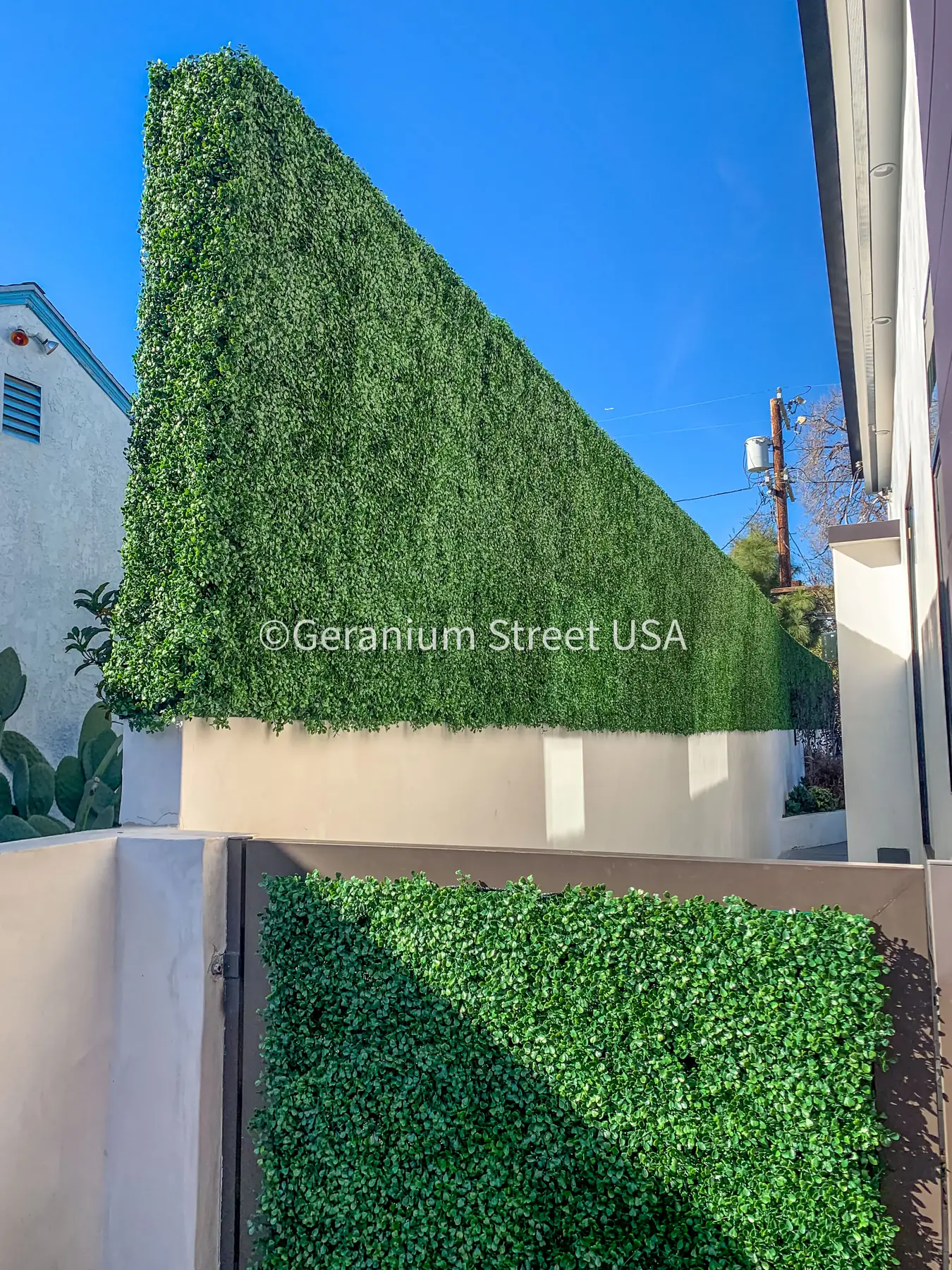
Boxwood panels are the most popular. They mimic the dense, small-leafed look of real boxwood hedges. These work well for privacy screening, fence toppers, and decorative borders. We cover the boxwood-vs-real-plants decision in detail in our artificial vs. real boxwood comparison.
Mixed greenery panels combine different leaf shapes—ferns, grasses, ivy, and other foliage—for a more natural, "wild garden" look. These tend to work well for living wall applications and commercial spaces where a uniform boxwood look would feel too formal.
Ivy and trailing panels are designed for vertical coverage on walls and fences. They create a cascading effect and can be effective for covering unattractive surfaces.
Privacy rolls are flexible sheets of dense foliage that attach directly to chain-link or wire fences. They're a straightforward option for converting an existing fence into a green privacy screen.
For a side-by-side breakdown of cost differences between these options and live plants, see our artificial hedges vs. real plants cost analysis.
How artificial hedges hold up in the Texas climate
Texas weather is the real test. Here's how each stressor affects artificial hedges and what to look for:
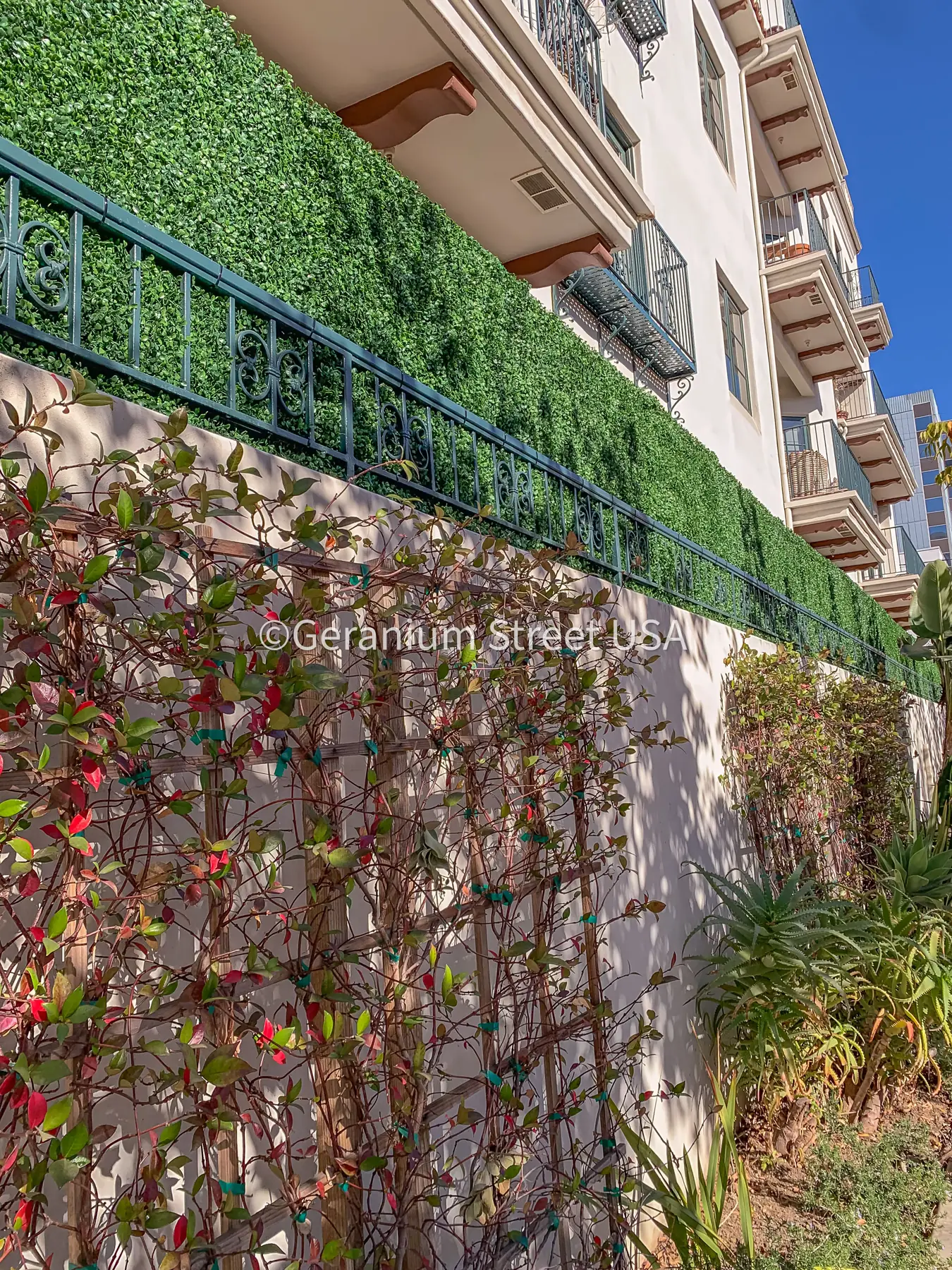
UV exposure
This is the single biggest factor. Texas gets intense, sustained UV exposure—particularly in Central and West Texas, where the sun is direct and relentless from April through October.
UV-stabilized polyethylene panels are engineered to resist this. Manufacturers add UV inhibitors during production that absorb ultraviolet radiation and convert it to heat, slowing the chemical degradation that causes fading and brittleness. The quality of this UV treatment is what separates a panel that holds its color for years from one that looks washed out in a single summer.
A practical tip: if the product is marketed for outdoor use in the southern United States, ask specifically about UV testing or warranties related to color retention. If the supplier can't provide that, it's a signal.
Heat
Surface temperatures on south- and west-facing walls in Dallas, Austin, or Houston can exceed 150°F during peak summer. Artificial hedge panels don't wilt or die from heat, but extreme temperatures can stress mounting hardware and cause expansion in backing grids.
The fix is straightforward: use heat-rated fasteners (stainless steel or coated), allow for slight expansion at seams, and when possible, create a small air gap between panels and the wall behind them. This prevents heat from getting trapped and reduces thermal stress on the panel backing.
Wind and storms
Texas thunderstorms arrive fast and hit hard. Wind is the primary threat to artificial hedges—not because the panels fail, but because poorly secured installations can lift, rattle, or peel at corners and seams.
Professional installation accounts for this by reinforcing attachment points at edges and seams, using heavier-gauge frames where wind exposure is high, and making sure the fastener pattern is tight enough to prevent flutter.
Dust and pollen
Central Texas is notorious for cedar pollen, and any outdoor surface collects dust. On artificial hedges, this shows up as a dull film that mutes the green color over time. A hose rinse every couple of months handles it. Near pools, roads, or construction, you may want to clean more often. Mild soap and water works for stubborn buildup.
The cost question
The most honest answer: artificial hedges cost more upfront than planting shrubs, but cost less over time because you eliminate every recurring expense—water, trimming, fertilizer, pest control, and plant replacement.
For a detailed breakdown with estimated ranges, read our full cost comparison of artificial vs. real hedges in Texas. The short version: initial costs for a quality artificial hedge and professional installation can be comparable to properly planting and establishing a live hedge. But from that point forward, the live hedge keeps costing money every year while the artificial one doesn't.
The water savings alone are significant. The Texas Water Development Board tracks drought conditions across the state, and many Texas cities—including Austin and San Antonio—maintain permanent watering restrictions. An artificial hedge removes landscape irrigation from the equation entirely.
HOA approval: what to expect
This comes up constantly. The short answer is that many Texas HOAs do approve artificial hedges, but you need to check your specific community's CC&Rs (Covenants, Conditions & Restrictions) before purchasing.
Some HOAs have language restricting "artificial landscaping" or "visible artificial elements." Others have no restrictions, and some have actually started recommending artificial options because they solve maintenance consistency issues across the community.
If your HOA requires an application:
- Get a product sample. A physical panel does more than any brochure. Let the architectural review committee see and touch the material.
- Include the product spec sheet. Show that it's UV-stabilized, the material type, and any fire ratings if applicable.
- Provide photos of completed installations. Real project photos showing the finished look help reviewers understand what they're approving.
- Describe the installation method. If it's going on a fence, explain how panels attach and how the finished installation will look from the street.
For more detail on HOA-friendly options, see our HOA-approved artificial hedge page.
Pool privacy: a natural fit
Pool areas are one of the most common applications for artificial hedges in Texas, and for good reason. Real hedges around pools face triple stress: reflected UV from the water, chlorine mist, and splashing. They also attract insects, drop leaves into the water, and need constant trimming to stay tidy.
Artificial hedges around pools avoid all of that. They provide instant, consistent privacy screening with zero debris in the water. The key considerations for pool installations:
- Chlorine exposure. Pool chemicals can land on nearby surfaces as mist. Outdoor-rated panels can still work well there, but product quality and periodic rinsing matter.
- Ground-level mounting. Pool deck fencing is usually low enough that wind is less of a concern, but make sure drainage isn't blocked if panels sit at grade level.
- Proximity to equipment. Keep clearance around pool pumps, filters, and heaters. Screening them from view is fine; blocking airflow is not.
We cover pool-specific options in more detail on our pool privacy hedge page.
Fence extensions and toppers
One of the most practical uses for artificial hedges in Texas is extending the effective height of an existing fence. If your fence is six feet but you want eight feet of screening, a two-foot artificial hedge topper can bridge the gap without building a taller fence.
This is especially relevant where local codes or HOA rules limit fence height. An artificial hedge topper mounted on top of an existing fence often falls into a different category than the fence itself, making it easier to add height without a variance.
We have a full page on fence extension options if this is your primary interest.
Installation: what matters most
The product only performs as well as the installation. The main installation approaches:
Fence-mounted panels attach directly to an existing wood, metal, or vinyl fence using UV-rated zip ties, screws, or clamps. This is the simplest installation method and works well when the fence is straight and solid.
Frame-mounted systems use aluminum or steel framing attached to posts or walls, with panels secured to the frame. This approach is more robust, allows for a consistent flat surface, and works well for freestanding screens and fence toppers.
Wall-mounted panels attach to masonry, stucco, CMU, or other wall surfaces using furring strips or a mounting grid. A small air gap behind the panels helps with heat dissipation—important for south- and west-facing walls in Texas.
In every case, the critical details are:
- Fastener quality. Use hardware rated for outdoor exposure. Cheap fasteners corrode quickly in Texas heat, rain, and coastal humidity.
- Seam connections. Where panels meet, the connection needs to be tight enough to resist wind flutter but allow for minor thermal expansion.
- Substrate condition. If the fence or wall is damaged, warped, or unstable, fix that first. The hedge will mirror whatever it's attached to.
A DIY installation can work for simple fence-mounted panels on a straight, solid fence. For frame-mounted systems, fence toppers, or anything at height, professional installation is worth the investment—both for the finished look and for long-term wind resistance.
Maintenance: what it actually takes
This is one of the genuine advantages of artificial hedges. The maintenance list is short:
- Rinse periodically. A garden hose on a gentle setting removes dust, pollen, and light debris. In Central Texas, quarterly rinsing keeps things looking good. Near a pool or busy road, monthly is better.
- Mild soap for heavier buildup. If rinsing alone doesn't cut it—sunscreen overspray near a pool, grease near a grill, road film—use mild dish soap diluted in water. Rinse thoroughly afterward.
- Inspect fasteners annually. Check that zip ties haven't degraded, screws are still tight, and panels are secure. Texas heat and UV can age some fastener types faster than others.
- Avoid harsh chemicals. Pressure washers, degreasers, and bleach can strip UV coatings or damage the leaf texture. If you're not sure, test a small hidden area first.
There is no trimming, no watering, no fertilizing, and no pest control. That's the promise, and it's real.
When artificial hedges are the right choice (and when they're not)
Artificial hedges make the most sense when:
- Water conservation is a priority. In a state where the Texas Commission on Environmental Quality tracks drought conditions and many cities enforce watering restrictions, eliminating irrigation for screening is a practical choice.
- Maintenance consistency matters. For rental properties, commercial sites, HOA common areas, or homeowners who travel, the "always looks the same" quality of artificial hedges is a genuine advantage.
- Speed matters. A live hedge takes years to fill in. Artificial hedges deliver full coverage on day one.
- The environment is harsh. Pool areas, west-facing walls, rooftops, and high-wind locations all favor materials that don't need to be kept alive.
Live plants may be a better fit if you enjoy gardening, have reliable irrigation access, and want the seasonal variation and ecological benefits of real vegetation. There's nothing wrong with either choice—it depends on what you're solving for.
Going deeper: related guides
We've written detailed articles on the topics this guide touches on. Each one goes deeper into a specific angle:
- Artificial hedges vs. real plants in Texas: which is cheaper? — Full cost breakdown over 10 years
- Artificial vs. real boxwood in Texas — Water, maintenance, and long-term value comparison
- Faux green walls vs. real plants for Texas homes — Side-by-side for residential applications
And for specific product options:
- Artificial hedge panels
- Artificial boxwood hedges
- Pool privacy hedges
- HOA-approved hedges
- Fence extensions
We install in every major Texas metro. See local pages for Dallas, Houston, San Antonio, and Sugar Land.
FAQ
How long do artificial hedges last in Texas?
With UV-stabilized materials and proper installation, commercial-grade artificial hedges can hold their appearance for years in direct Texas sun, but performance still depends on product quality, placement, and maintenance.
Do artificial hedges look fake?
Not the good ones. Premium panels use multiple shades of polyethylene, varied leaf sizes, and randomized patterns to mimic natural growth. From a few feet away, most people cannot tell the difference. The key is avoiding the cheapest options, which tend to use uniform color and shiny plastic.
Are artificial hedges allowed by Texas HOAs?
Many Texas HOAs approve artificial hedges, especially when the product looks realistic and is professionally installed. Some HOAs have restrictions on visible artificial elements, so check your CC&Rs before purchasing. Submitting a sample panel with your application often helps.
Do artificial hedges need maintenance?
Very little. A rinse with a garden hose every few months removes dust and pollen. For heavier buildup near pools or roads, mild soap and water works. There is no trimming, watering, fertilizing, or pest control required.
Can artificial hedges withstand Texas storms?
When installed with proper framing and fasteners rated for the conditions, yes. Wind is usually the biggest concern—secure mounting at seams and corners prevents panels from lifting. Professional installation accounts for wind loads specific to your location.
How much do artificial hedges cost in Texas?
Costs vary based on product quality, project size, and installation method. Premium UV-stabilized panels and professional installation are more expensive upfront than planting shrubs, but the total cost over 5 to 10 years is typically lower because you eliminate water, trimming, pest control, and replacement costs.
Have a specific project in mind? Request a free quote or explore our full product lineup.
References
- Texas Water Development Board: https://www.twdb.texas.gov/
- Texas Commission on Environmental Quality (drought and water restrictions): https://www.tceq.texas.gov/
Need a next step?
Need an HOA-friendly privacy option?
Send the fence length, target height, and photos. We can point you to the cleanest path for backyard privacy without live-plant upkeep.
Ready for the next step?
Use the page that fits your project best
Pick the shortest path based on whether you need pricing, a service page, or a local planning page.