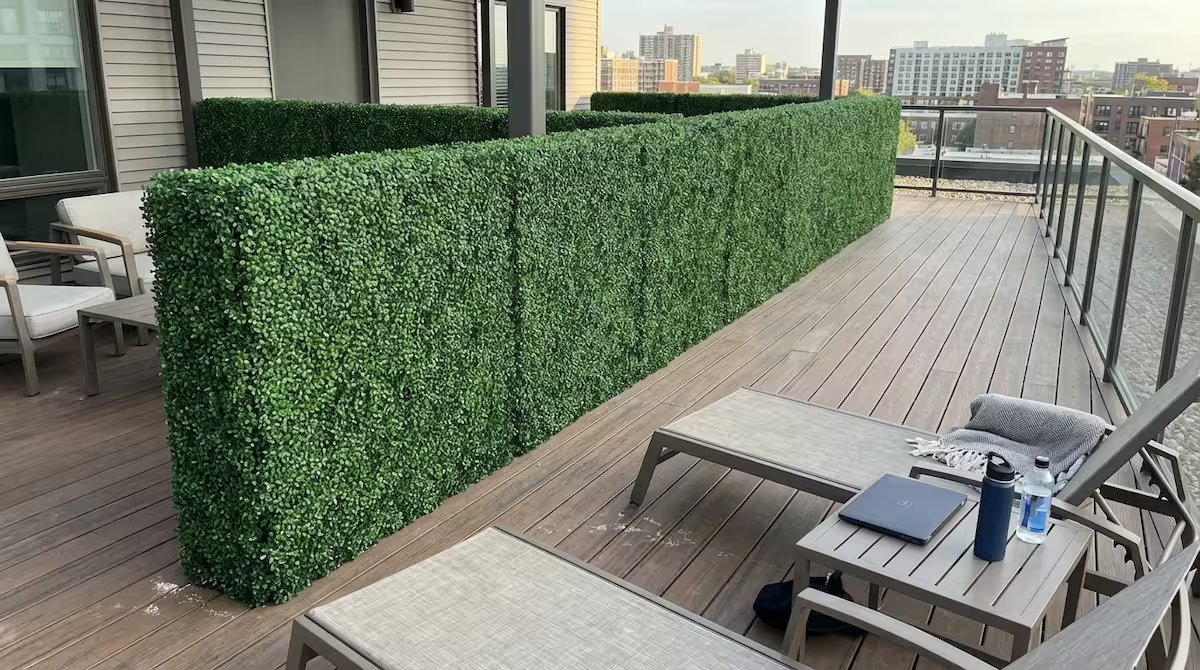
If you manage a multifamily property in Texas, you already know what landscaping costs. Not the line item on the budget—the real cost. The irrigation repairs after a freeze. The replanting after a drought. The seasonal color that looks good for six weeks and brown for three months. The crew that comes weekly whether there's anything to do or not.
Artificial greenery—hedges, living walls, screening panels—doesn't eliminate your entire landscaping budget. But for the specific areas where it replaces live plantings, the financial math is straightforward: you spend more upfront and significantly less every year after.
Planning a similar project? See commercial greenery installs →.
This article breaks down the cost categories where artificial greenery saves money on multifamily properties, the areas where it doesn't, and how to think about the ROI conversation with ownership.
The cost categories that change
Water
The EPA estimates that outdoor water use accounts for roughly 30 percent of residential water consumption nationally. In arid and semi-arid regions—which describes most of Texas west of I-35 and increasingly applies to the I-35 corridor during drought years—that share can reach 60 percent.
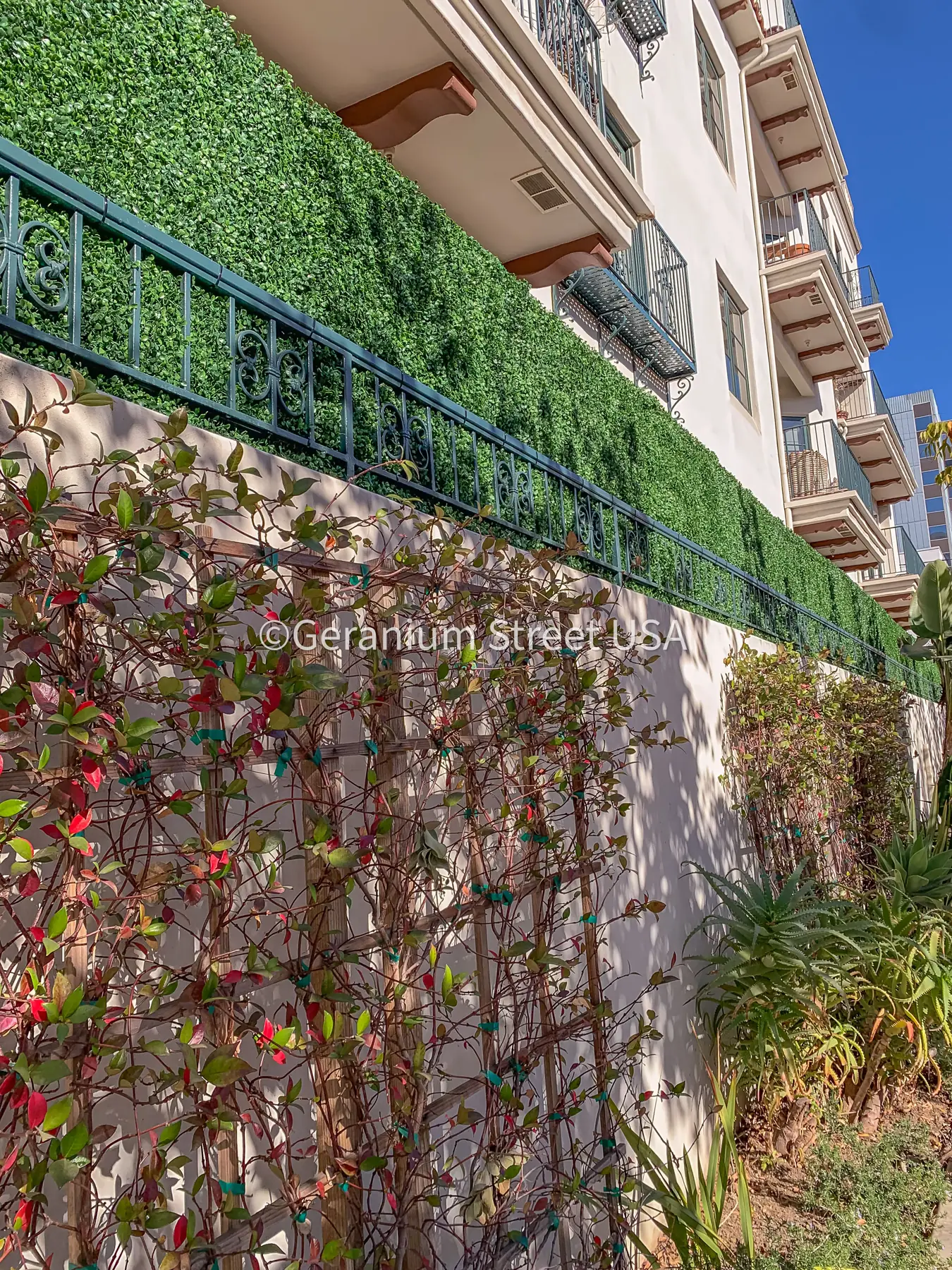
On a multifamily property, irrigation is a significant line item. Hedges, foundation plantings, accent shrubs, and courtyard greenery all need water, and in Texas they need it most during the months when water is most expensive and most restricted.
The Texas Water Development Board tracks drought conditions and water supply planning across the state. During the 2022-2023 drought cycle, many Texas cities imposed mandatory watering restrictions that made maintaining live landscaping difficult and expensive. Some jurisdictions imposed surcharges for above-threshold water use.
Artificial greenery uses zero water. Every square foot of hedge or living wall that replaces irrigated plantings reduces your water bill permanently. It also eliminates the irrigation system maintenance for those areas—no sprinkler heads to replace, no controller adjustments, no winterization.
Ongoing landscape maintenance
Live hedges need trimming (typically monthly during the growing season in Texas), fertilizing, pest treatment, and irrigation monitoring. The labor adds up—especially for properties with extensive hedge lines along fences, around pools, and screening utility areas.
Artificial hedges need occasional rinsing with a garden hose and an annual fastener check. That's it. There's no mowing, edging, trimming, fertilizing, or pest control. On a per-square-foot basis, the annual maintenance cost for artificial greenery is a fraction of the equivalent live planting.
Plant replacement
This is the cost category that often gets underestimated in live landscaping budgets. In Texas, plant replacement is not an occasional event—it's a recurring one.
Freeze damage. The February 2021 winter storm (Uri) killed or damaged landscaping across most of the state. Properties that had invested in mature live hedges and foundation plantings faced five-figure replacement bills. The same happened to varying degrees during subsequent cold events.
Drought stress. Even with irrigation, prolonged heat and watering restrictions cause die-off in live hedges. Boxwood, ligustrum, and other common hedge plants suffer during extended 100+ degree stretches, especially when water restrictions limit irrigation to once or twice per week.
Seasonal die-off. Some accent plantings are seasonal by nature. Properties that install seasonal color beds or tender perennials budget for replacement two to four times per year.
Artificial greenery doesn't freeze, doesn't drought-stress, and doesn't need seasonal replacement. A quality UV-stabilized installation can hold its appearance for years outdoors in Texas, depending on sun exposure, placement, and maintenance, without the recurring replacement cycle of live plants.
Pest and chemical treatment
Live hedges and foundation plantings attract insects, require fertilizer, and sometimes need fungicide or herbicide applications. On multifamily properties, chemical applications near pools, playgrounds, and common areas create resident notification requirements and scheduling constraints.
Artificial greenery needs none of this. No fertilizer, no pesticide, no herbicide, no chemical applications of any kind.
The cost categories that don't change
Planning a similar project?
Use these next pages while you read
They cover pricing, service details, and the next planning step without making you leave the article blind.
To be clear about what artificial greenery doesn't affect:
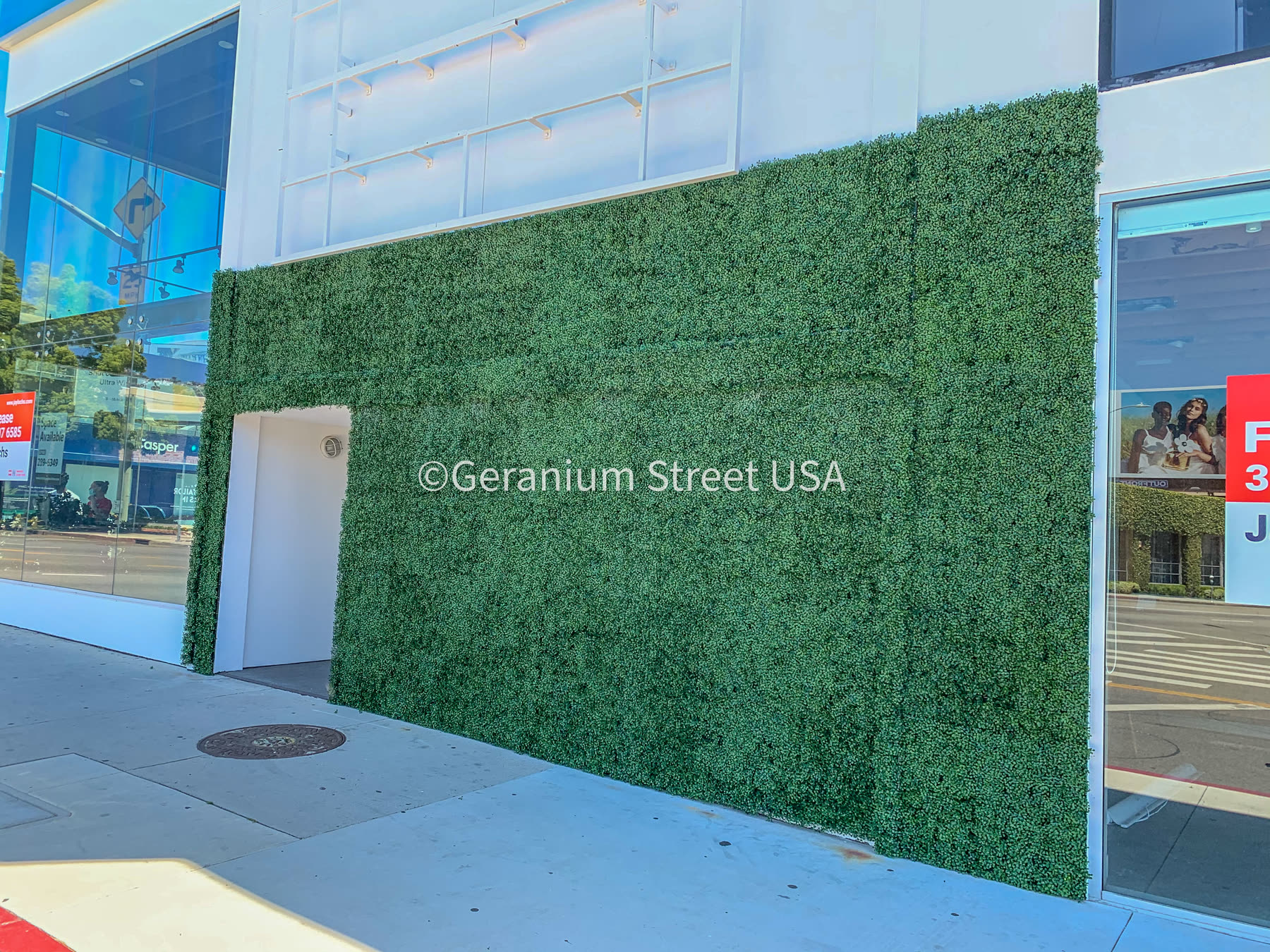
Turf maintenance. If your property has lawn areas, you still need mowing, edging, and irrigation for those. Artificial greenery replaces hedges, accent plantings, and wall-mounted greenery—not turf.
Tree care. Trees are a separate category with their own maintenance requirements. Artificial greenery doesn't replace shade trees.
Hardscape maintenance. Parking lots, sidewalks, pool decks, and other hardscape elements have their own costs that aren't affected.
General grounds labor. You'll still need grounds crews for the areas that remain live. The savings come from reducing the scope of what those crews need to maintain, not eliminating them.
Where multifamily properties get the most value
Not every planting area on a property is a good candidate for artificial greenery. The highest-value replacements tend to be:
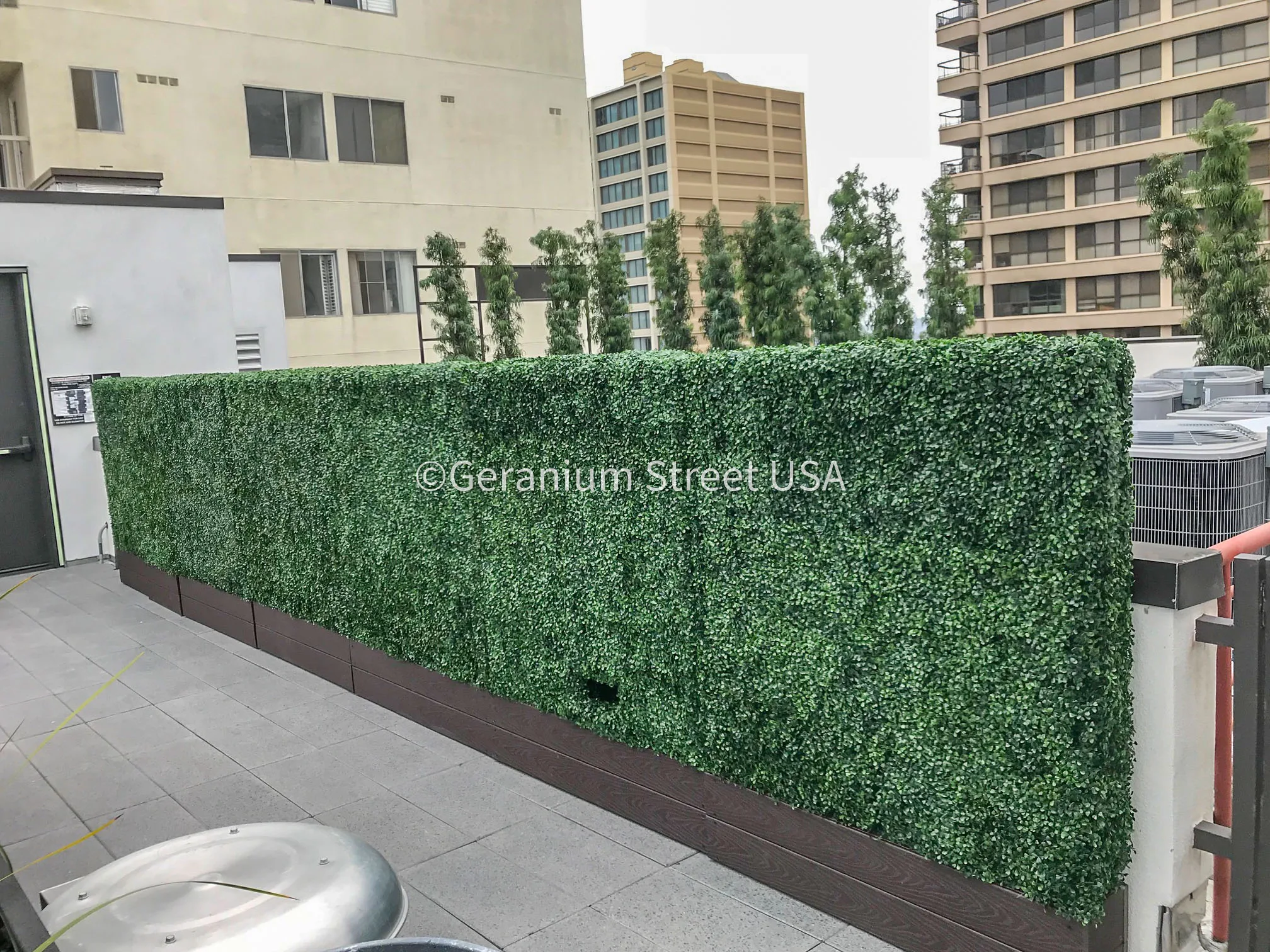
Pool and courtyard areas
Pool surrounds are brutal on live plants. Reflected UV from the water, chlorine mist, splashing, and foot traffic combine to stress plants constantly. Live hedges near pools drop leaves into the water, clog skimmers, and increase chemical demand. Artificial hedges eliminate all of that.
For a deeper look at pool-specific applications, see our pool privacy guide.
Fence-line privacy screening
Perimeter fences on multifamily properties are often the most visible landscaping element for residents and prospects. A hedge screen on a 6-foot fence provides privacy, improves appearance, and doesn't require irrigation infrastructure along the fence line (which is expensive to install and maintain).
Utility and equipment screening
Trash enclosures, pool equipment, HVAC systems, electrical panels—these all benefit from visual screening. Artificial hedge panels hide them without the irrigation, trimming, and replacement costs that live screening requires.
For properties considering fire-rated options near these areas, see our guide on firewise artificial hedges for multifamily properties.
Leasing office and amenity entries
First impressions happen at the leasing office entrance and amenity areas. A live hedge that's brown in August or damaged after a freeze sends the wrong message to prospects. Artificial greenery looks the same year-round—which means your curb appeal doesn't have a seasonal dip.
The National Apartment Association consistently identifies curb appeal and amenity presentation as factors in leasing performance. While no published study isolates artificial greenery as a specific driver, consistent appearance during every season and every market condition eliminates a variable that live landscaping introduces.
The fire compliance factor
On multifamily properties, fire compliance adds a layer that residential projects don't face. Artificial greenery in courtyards, along egress paths, and in interior common areas may need to meet fire code requirements depending on the jurisdiction and installation location.
Fire-rated products—tested to standards like NFPA 701—are available and commonly specified for commercial multifamily applications. The upfront cost for fire-rated products is higher than standard panels, but the compliance documentation protects you during inspections and insurance reviews.
Our fire-rated artificial greenery guide covers the standards, documentation, and procurement details for commercial properties. The NFPA 701 vs ASTM E84 comparison explains the specific test standards and when each applies.
How to present the case to ownership
Property managers typically need to justify capital spending to ownership groups or asset managers. Here's how to frame the artificial greenery conversation:
Frame it as cost avoidance, not just a purchase. The upfront cost is real, but so is the ongoing cost it eliminates. Present the comparison across a 5-year or 10-year window, not just year one.
Quantify your current spend. Pull your actual landscaping invoices for the target areas—irrigation, maintenance, replacement, and chemical treatment. Use your real numbers, not estimates.
Include the weather events. If your property replaced landscaping after a freeze, drought, or storm, include that cost. These events aren't one-time—they're recurring in Texas.
Note the water conservation angle. Water conservation is increasingly relevant in Texas. Texas Property Code Section 202.007 prohibits HOAs from unreasonably denying drought-resistant landscaping, reflecting the state's recognition that water scarcity is a long-term reality. Artificial greenery aligns with this direction.
Address the upfront cost directly. Ownership will ask about payback period. With the ongoing savings in water, maintenance, and replacement, most installations pay for themselves within a few years. The exact timeline depends on your property's current spend, the scope of the installation, and local water rates.
Related articles
This article is part of our fire-rated artificial greenery guide for Texas commercial properties, which covers fire test standards, documentation, and compliance for commercial projects.
You might also find these useful:
- Firewise artificial hedges for multifamily properties
- NFPA 701 vs ASTM E84: fire ratings for artificial greenery explained
For product options, see our fire-rated artificial hedge page, commercial living wall page, or Vallum FRX system.
FAQ
How much water do artificial hedges save on a multifamily property?
Artificial hedges use zero water. According to the EPA, outdoor water use accounts for roughly 30 percent of residential consumption nationally, and that share can reach 60 percent in arid and semi-arid climates. On a multifamily property where hedges, shrubs, and accent plantings require regular irrigation, the water savings from switching those areas to artificial greenery depends on the size of the planted area, the irrigation schedule, and local water rates.
What is the lifespan of artificial greenery on a multifamily property?
Indoors, quality artificial greenery can hold its appearance for many years. Outdoors in Texas, performance depends on sun exposure, placement, product quality, and maintenance. That still compares favorably to live plants that often need partial or full replacement after freezes, drought, or seasonal die-off.
Do artificial hedges improve occupancy or leasing?
There is no published study isolating artificial hedges as a leasing driver. However, the National Apartment Association consistently identifies curb appeal and amenity appearance as factors in prospect decision-making. Artificial greenery provides consistent year-round appearance regardless of season, drought, or freeze events—which eliminates the seasonal dips in curb appeal that affect live landscaping in Texas.
Are artificial hedges a capital expense or operating expense?
Classification depends on your accounting standards and the scope of the project. Smaller installations may be treated as operating expenses. Larger projects—especially those involving structural frames or permanent mounting systems—are often capitalized as property improvements. Consult your accountant for your specific situation.
References
- EPA WaterSense — How We Use Water: https://www.epa.gov/watersense/how-we-use-water
- Texas Water Development Board: https://www.twdb.texas.gov/
- NFPA 701, Standard Methods of Fire Tests for Flame Propagation of Textiles and Films: https://www.nfpa.org/codes-and-standards/nfpa-701-standard-development/701
- Texas Property Code Section 202.007: https://statutes.capitol.texas.gov/SOTWDocs/PR/htm/PR.202.htm
- National Apartment Association: https://www.naahq.org/
Need a next step?
Need a real starting number for your project?
Use the pricing page for quick benchmarks, then send dimensions and photos for a tighter range.
Ready for the next step?
Use the page that fits your project best
Pick the shortest path based on whether you need pricing, a service page, or a local planning page.