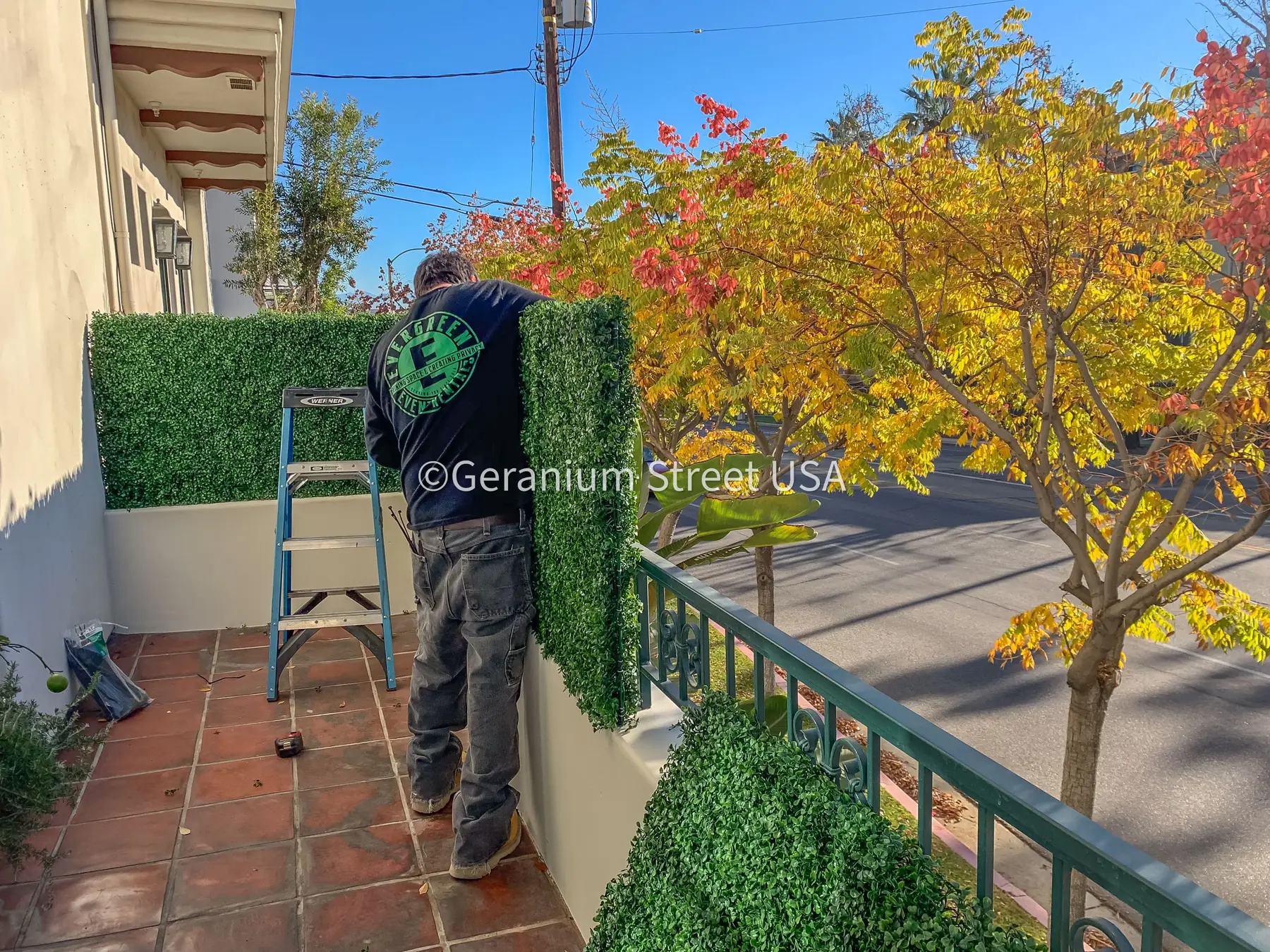
Homeowner approval guide
Know what to submit, what the HOA is likely to care about, and what to verify before you treat a denial as final.
Quick Answers
What most readers need to know first
Do most homeowners need HOA approval first?
Yes, if the property sits in a deed-restricted community with architectural review.
What makes approval smoother?
A complete submission with a sample, photos, site plan, and a clear water-conservation argument.
What is the biggest mistake?
Submitting too little detail and waiting until denial to clarify scope.
Decision Snapshot
The shortest practical summary
Read the CC&Rs and architectural guidelines before choosing a product.
A clean visual result, clear placement, and enough documentation to understand the request.
When the homeowner assumes the hedge will be understood without a complete package.
If you live in a deed-restricted community in Texas—and most newer subdivisions are—you probably need architectural review approval before installing an artificial hedge. That's not a reason to avoid the project. It's just a process, and one that goes smoothly when you understand what your HOA is actually looking for and what the law says about your rights.
This guide walks through the process step by step: what Texas law requires of HOAs, what to put in your application, how to handle objections, and what to do if you're denied.
Planning a similar project? See HOA-friendly hedge options →.
What Texas law says about HOA landscaping restrictions
Two sections of the Texas Property Code are relevant:
Chapter 209: Texas Residential Property Owners Protection Act
This is the main statute governing residential HOAs in Texas (for associations of 40 or more lots). Section 209.00505 establishes rules for architectural review:
- The HOA's architectural review authority can approve or deny requests for modifications and improvements.
- If a request is denied, the HOA must describe the basis for denial in reasonable detail and any changes required as a condition of approval.
- The homeowner has the right to request a hearing within 30 days of receiving the denial notice.
- The board must hold the hearing within 30 days of your request, and must notify you of the date, time, and place at least 10 days in advance.
- The board can affirm, modify, or reverse the architectural review committee's decision.
In plain language: they can't just say "no" without explanation, and you have a structured path to appeal.
Section 202.007: Water conservation protections
Texas Property Code Section 202.007 directly addresses water-conserving landscaping. It prohibits HOAs from:
- Unreasonably denying or withholding approval of drought-resistant landscaping
- Prohibiting rain barrels, rainwater harvesting systems, or efficient irrigation systems (including drip systems)
- Assessing fines for failure to maintain green vegetation during watering restrictions or within 60 days after restrictions are lifted
This matters because one of the strongest arguments for artificial hedges is water conservation. While Section 202.007 specifically names "drought-resistant landscaping" and "water-conserving natural turf," the spirit of the law is clear: Texas recognizes that water scarcity makes traditional landscaping requirements impractical, and HOAs cannot unreasonably stand in the way of conservation-minded alternatives.
Whether artificial hedges are covered directly by Section 202.007 has not been definitively settled by Texas courts. But the water-conservation argument—paired with the product's realistic appearance and zero irrigation requirement—gives you strong footing for your application.
Before you apply: read your CC&Rs
Planning a similar project?
Use these next pages while you read
They cover pricing, service details, and the next planning step without making you leave the article blind.
Planning Grid
What To Lock Down Before You Submit
Use this planning grid before you send the application package.
Where the hedge goes, total height, and whether the project changes the fence line.
The exact product, color, realism level, and supporting photos.
Spec sheet, physical sample, photos, and a simple site sketch.
Municipal permit needs, if the project changes structure or height.
Your HOA's CC&Rs (Covenants, Conditions & Restrictions) and architectural guidelines are the first documents to check. Look for language about:
- "Artificial landscaping" or "artificial plants" — Some CC&Rs explicitly allow or prohibit these. If yours are silent on the topic, that's usually a good sign.
- "Natural materials only" — If your CC&Rs require "natural" landscaping materials, you'll need to make a case for why the artificial hedge should qualify as a permitted modification.
- Fence height restrictions — If you're adding a hedge topper to extend fence height, check whether the CC&Rs limit total fence-plus-topper height. Many Texas communities cap residential fences at 6 to 8 feet. City ordinances may also apply.
- Color and appearance standards — Some HOAs require that modifications "match the aesthetic character" of the neighborhood. Premium artificial hedges typically meet this standard easily, but you'll want to document it.
- Approval process and timeline — Your governing documents should specify the submission requirements (application form, drawings, samples) and the timeline for review.
If you can't find your CC&Rs, request a copy from your HOA management company. Texas Property Code Section 209.005 requires the association to make governing documents available to owners.
What to include in your application
A strong application removes the guesswork for the review committee. Here's what to submit:
Checklist
Application Checklist
Use this to make the HOA review easier, faster, and less emotional.
- Completed application form or written request.
- Product spec sheet with dimensions and material description.
- A physical sample panel if possible.
- Completed-install photos using the same or similar product.
- A simple site plan or fence sketch.
1. Completed application form
Use whatever form your HOA provides. If there's no standard form, write a clear letter describing the modification.
2. Product specification sheet
Include the manufacturer's spec sheet showing:
- Material type (polyethylene, UV-stabilized)
- UV warranty or rating
- Fire rating documentation, if applicable (relevant for communities with wildfire risk)
- Dimensions and panel format
3. A physical sample panel
This is the most effective item you can include. A 12"x12" sample panel lets the committee see and touch the product. It's much harder to deny something that looks realistic when it's sitting on the table in front of the committee.
4. Photos of completed installations
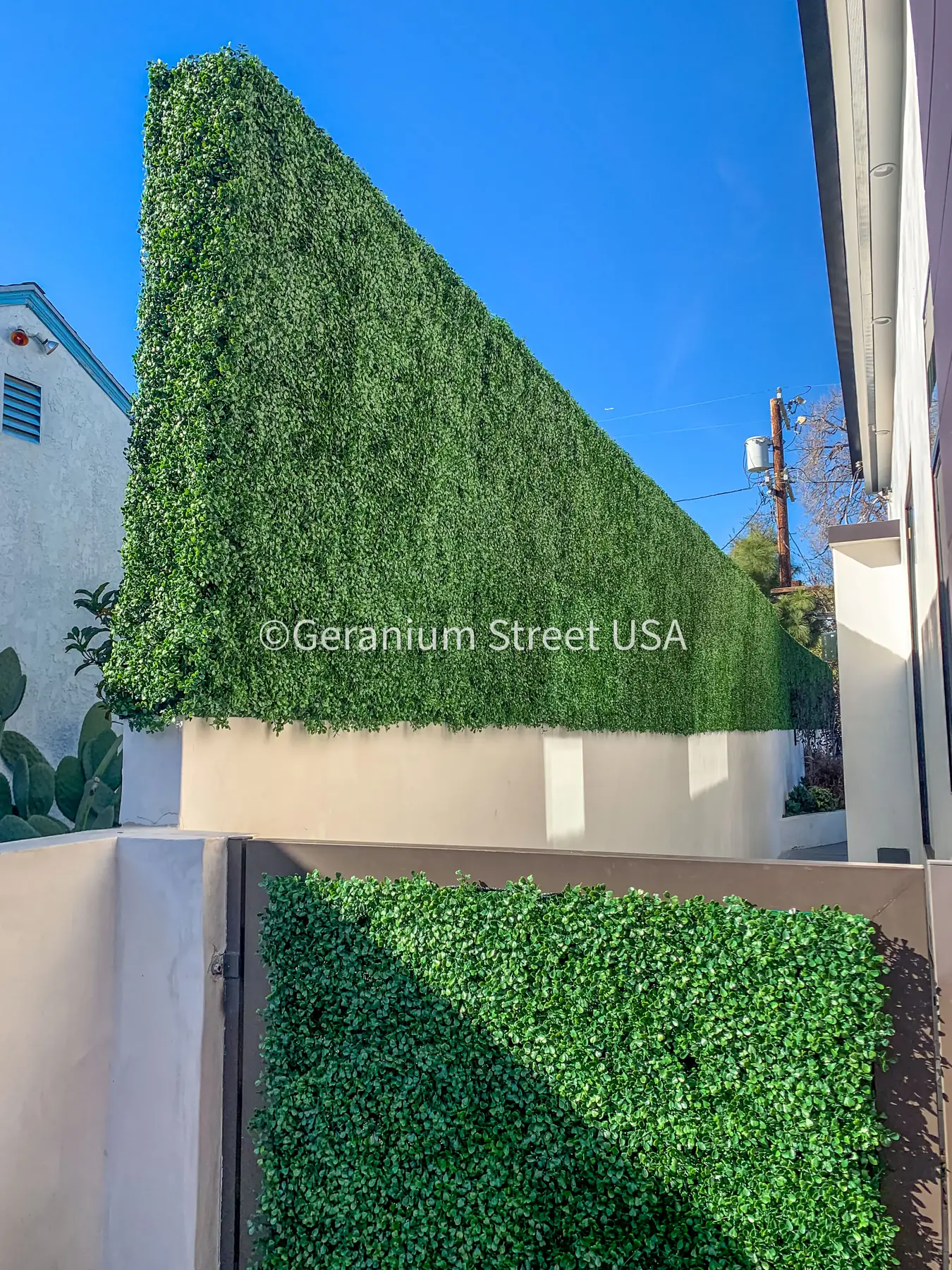
Include photos showing the finished look of the same product on similar fences or walls. Real-world installation photos are more convincing than catalog images.
5. Site plan or sketch
Show where the hedge will be installed on your property. Include the fence line, the location relative to the house and street, and the proposed height. If it's visible from the street or common areas, note that.
6. Installation description
Describe how the panels will be attached (zip ties, screws, frame system) and confirm that the existing fence or structure is in good condition. Note whether a professional installer will do the work.
7. Water conservation argument
If your community has experienced watering restrictions—and most Texas communities have—include a brief note about the water savings. Reference Section 202.007 of the Texas Property Code and the fact that the installation requires zero irrigation, zero fertilizer, and zero ongoing water use.
Common objections and how to address them
"It will look fake and hurt property values"
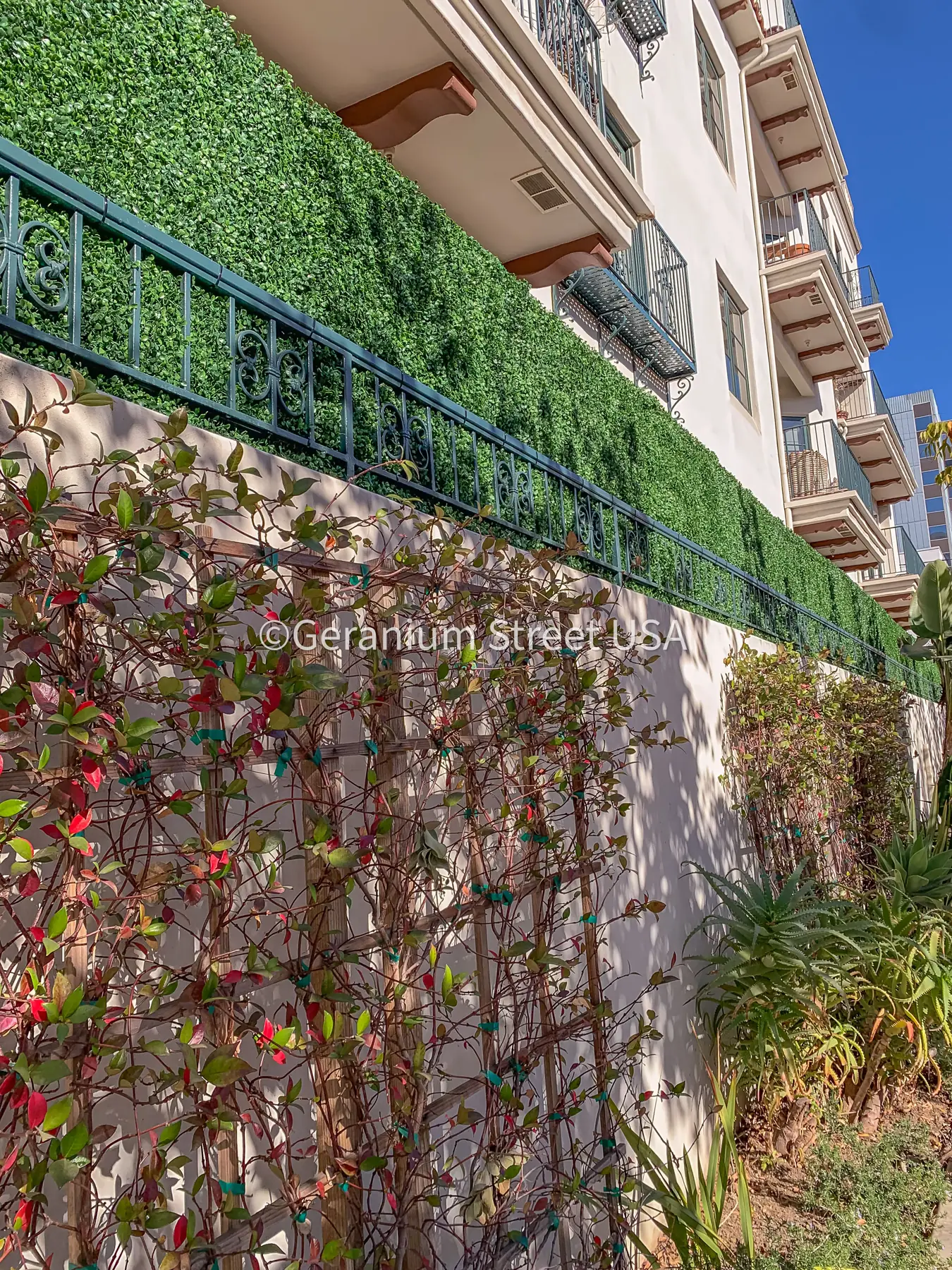
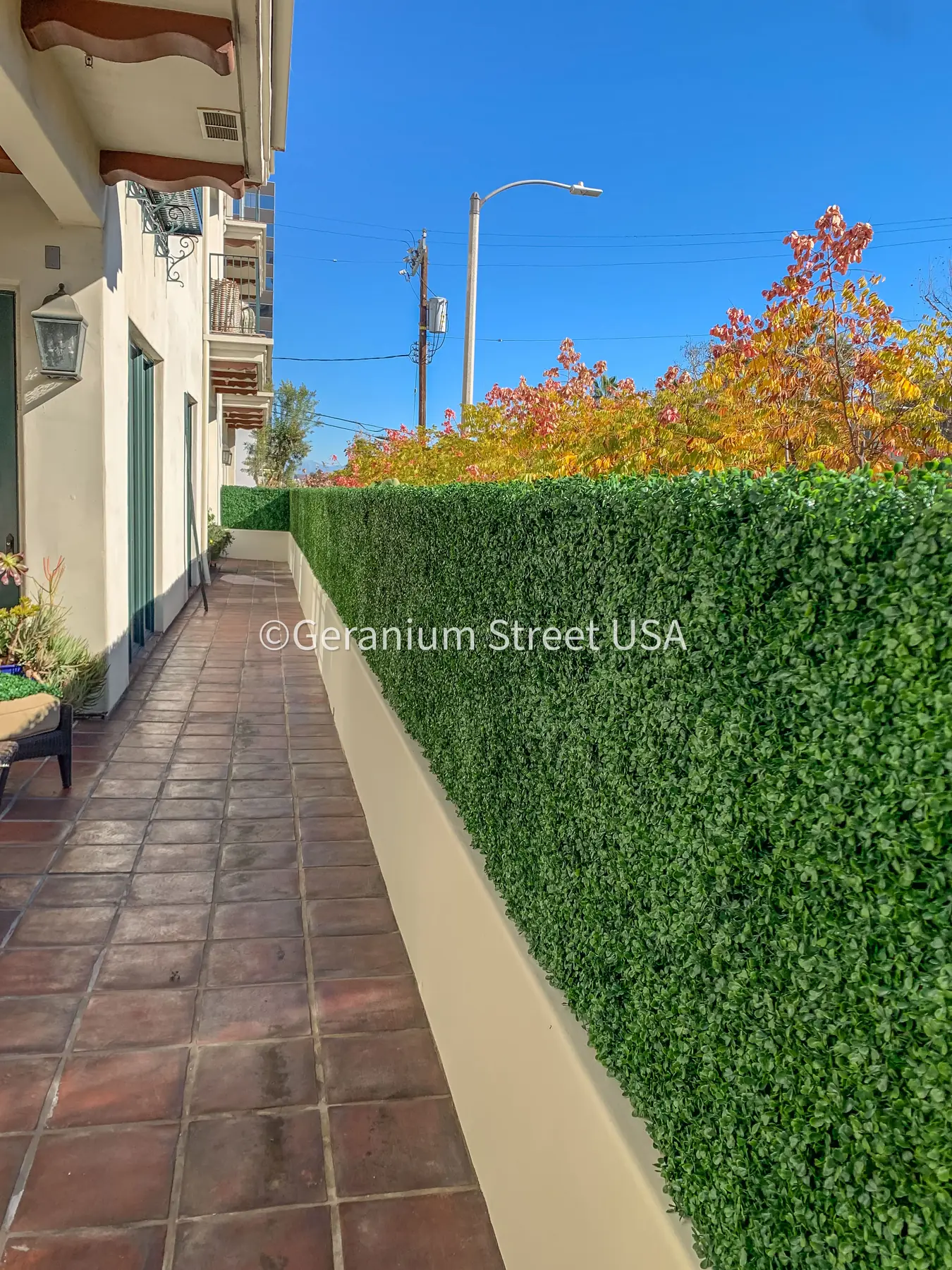
Bring a sample panel. Premium artificial hedges use varied leaf sizes, multiple shades of green, and randomized placement to mimic real boxwood. Most committee members who see a quality sample in person change their minds. You can also offer to install a test section for the committee to review before committing to the full project.
"Our CC&Rs require natural landscaping"
Point out that the CC&Rs likely don't define "natural" in a way that specifically excludes UV-stabilized artificial greenery. Many HOAs have approved artificial turf (which is common in Texas) using similar reasoning. The intent of the restriction is usually about appearance, not material composition.
"It doesn't match the neighborhood"
If other homes in the subdivision have varied fence styles, landscaping choices, or different levels of maintenance, the "neighborhood consistency" argument is weak. A well-maintained artificial hedge is more consistent than a live hedge that's brown in August and patchy after a freeze.
"We haven't approved this before"
That's not a reason for denial under Texas law. The HOA is required to evaluate your specific request based on the CC&Rs, not based on precedent. Being the first applicant isn't a disqualifier.
If your application is denied
You have rights under Texas Property Code Section 209.00505:
- The denial must state the specific reasons in reasonable detail.
- The denial must describe any changes that would make the application approvable.
- You can request a hearing within 30 days of receiving the denial.
- The board must hold the hearing within 30 days of your request and give you at least 10 days' notice.
- At the hearing, both you and the board have the opportunity to discuss facts and resolve the issue.
- The board can affirm, modify, or reverse the original decision.
If you go to a hearing, bring your sample panel, your spec sheet, and your photos. Keep it factual and professional. Most boards are made up of homeowners who want the neighborhood to look good—if you can show them the product looks good, the path to approval gets easier.
Tips that increase your chances
- Talk to a board member informally first. Before submitting anything, ask a neighbor who sits on the architectural committee what they think. An informal conversation can reveal objections early so you can address them in your application.
- Offer a trial period. Some homeowners offer to install a small section (one fence panel) for 30 to 60 days so the committee can see it in real conditions. This removes the "unknown" factor.
- Get neighbor support. If adjacent neighbors are supportive—or even interested in installing their own—mention that in your application. It signals that the modification is welcome, not controversial.
- Keep your existing fence in good shape. If the fence underneath is leaning, rotting, or damaged, fix it first. A committee that sees a damaged fence will focus on that instead of the hedge panels.
Related articles
This article is part of our complete guide to artificial hedges in Texas, which covers types, materials, climate performance, costs, and more.
You might also find these useful:
For HOA-friendly product options, see our HOA-approved artificial hedge page or request a free quote.
We help homeowners navigate HOA approvals in Dallas, Houston, San Antonio, Sugar Land, and across Texas.
FAQ
Can my HOA ban artificial hedges in Texas?
HOAs can regulate the appearance and type of landscaping through their CC&Rs, including artificial elements. However, Texas Property Code Section 202.007 prohibits HOAs from unreasonably denying drought-resistant landscaping. Whether artificial hedges fall under this protection depends on how your HOA and the courts interpret the statute. The safest approach is to submit a well-documented application rather than argue the legal question.
How long does HOA approval usually take?
Most Texas HOA architectural review committees are required to respond within 30 to 60 days, depending on the association's governing documents. Texas Property Code Section 209.00505 establishes appeal procedures if your request is denied, including the right to a hearing within 30 days of your appeal.
What if my HOA denies my artificial hedge application?
Under Texas Property Code Section 209.00505, the denial must describe the basis in reasonable detail and any changes required for approval. You have the right to request a hearing within 30 days. The board must hold the hearing and can affirm, modify, or reverse the decision.
Do I need a permit for an artificial hedge in Texas?
Permit requirements depend on the city, fence height, mounting method, and whether structural work is involved. HOA approval is separate from municipal requirements, so check both before installing.
References
- Texas Property Code Chapter 209 (Texas Residential Property Owners Protection Act): https://statutes.capitol.texas.gov/Docs/PR/htm/PR.209.htm
- Texas Property Code Section 202.007 (water conservation landscaping protections): https://statutes.capitol.texas.gov/SOTWDocs/PR/htm/PR.202.htm
Truthfulness Check
What To Verify
- Whether the CC&Rs speak directly about artificial landscaping.
- Whether height changes trigger a city or HOA issue.
- Whether your application clearly shows the finished appearance, not just the product name.
Where to go next
Choose the next page that fits your project
Need a next step?
Need an HOA-friendly privacy option?
Send the fence length, target height, and photos. We can point you to the cleanest path for backyard privacy without live-plant upkeep.
Ready for the next step?
Use the page that fits your project best
Pick the shortest path based on whether you need pricing, a service page, or a local planning page.