What Section 202.007 actually says
If you're a Texas homeowner trying to install an artificial hedge and your HOA is pushing back, you've probably seen "Texas Property Code 202.007" mentioned online. Here's what it actually says — and where the gray area is.
The law also says:
Planning a similar project? See HOA-friendly hedge options →.
The gray area: does 202.007 cover artificial hedges?
Planning a similar project?
Use these next pages while you read
They cover pricing, service details, and the next planning step without making you leave the article blind.
Here's where we need to be honest.
The argument that artificial hedges qualify: An artificial hedge uses no irrigation water and cannot die during drought. A homeowner could argue that the statute's failure to define the term leaves room for a water-conservation interpretation.
The argument that they don't qualify: The statute specifically says "water-conserving natural turf" in one clause, suggesting the legislature was thinking about real plants. An HOA could argue that "landscaping" implies living material and that plastic panels are a structure, not landscaping.
The practical reality: Approval often turns on the quality of the application, the CC&Rs, and the committee's design standards. The statute can be a useful backstop if you're denied, but it is not an automatic approval path.
How to get your artificial hedge approved (the real process)
Forget the legal arguments for now. Here's what actually gets approvals through Texas HOA architectural review committees:
What to include in your submission package
The more professional your application, the less room the committee has to claim "aesthetic incompatibility." Here's the complete checklist:
- Site plan showing exact location of the hedge on your property, including distances from property lines and structures
- Dimensions — height, length, and depth of the proposed installation
- Product photos — close-up foliage detail AND photos of the same product installed on a similar property (your installer should provide these)
- Material specifications — foliage type, UV stabilization rating, color description, and manufacturer if available
- Fire rating documentation — NFPA 701 test reports if applicable (especially for multifamily or commercial-adjacent properties)
- Mounting method — how the hedge attaches to the fence, wall, or frame. Committees want to know it won't fall apart.
- Maintenance commitment — a brief note that you'll rinse the hedge annually and address any damage. This eliminates the "it'll look bad over time" objection.
What to do if your HOA denies your request
Don't panic. Denials happen, and Texas law gives you a clear path forward.
If the denial reason is purely aesthetic and your product is consistent with the neighborhood, Section 202.007 may be worth discussing with the board or qualified legal counsel. But again — whether artificial hedges fall under 202.007 was not resolved by the sources reviewed for this article, so do not treat the statute as automatic approval.
Arguments that strengthen your case
If you're pushing back on a denial, these points carry weight with HOA boards:
- Water conservation. Texas faces recurring drought. Your hedge uses zero water. Reference TCEQ water restrictions data and TWDB outdoor water use statistics showing 31% of residential water goes to outdoor purposes.
- Consistency. If your HOA has approved artificial turf for any homeowner, they've already set a precedent for approving synthetic materials in landscaping.
- Maintenance. Artificial hedges maintain a consistent appearance year-round. Dead, brown, or overgrown natural hedges are the aesthetic problem HOAs are actually trying to prevent.
- Fire documentation. If fire performance matters for the project, include product-specific test documentation and ask the HOA what standard they expect to review.
Common HOA objections and how to address them
"It will look fake." Provide close-up photos of modern commercial-grade foliage. Mixed-species panels with varied tones are difficult to distinguish from real plants at conversational distance. Offer to install a small sample section for the committee to inspect.
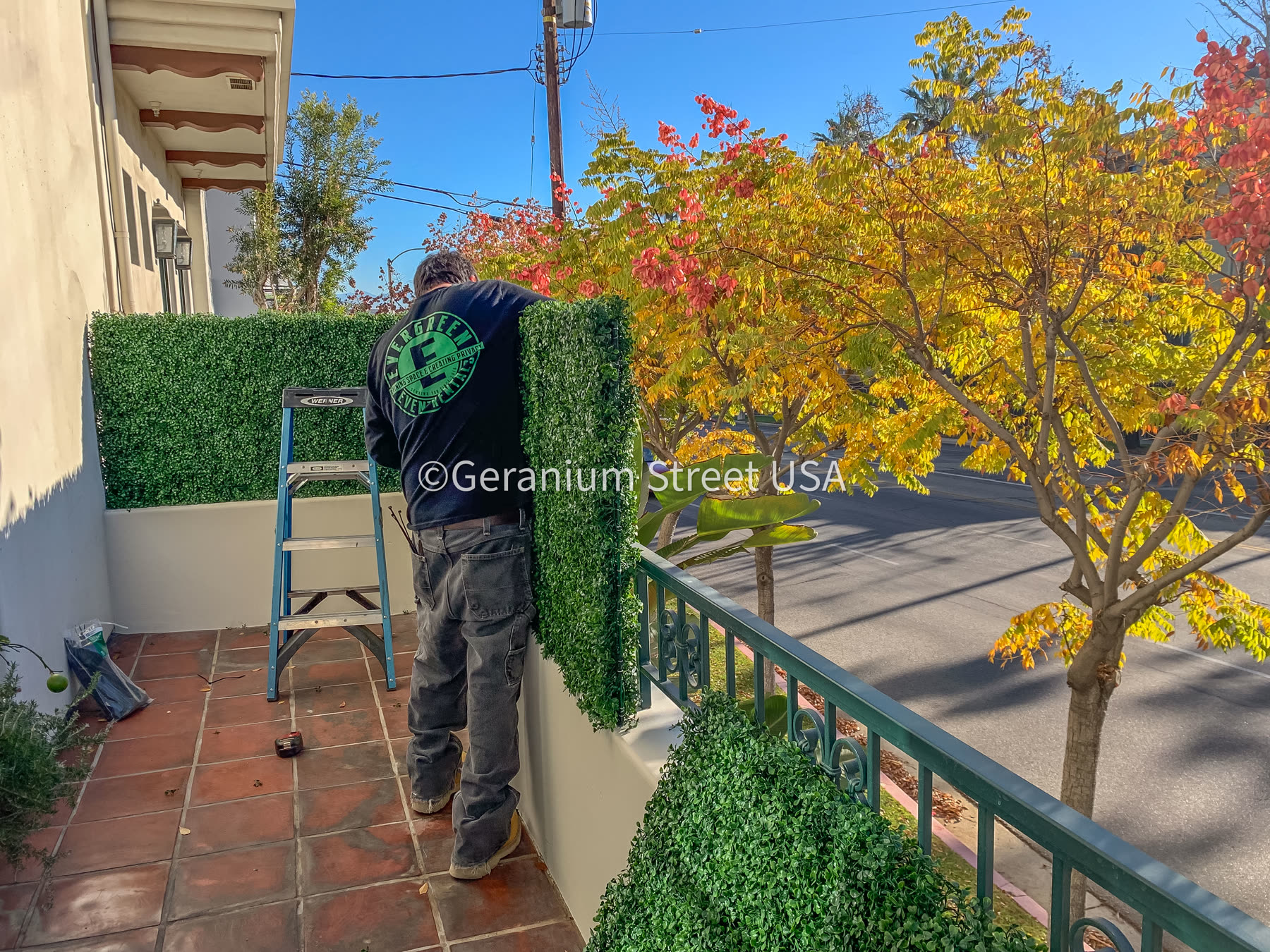
"It's not landscaping, it's a structure." Technically, an artificial hedge mounted on an existing fence is a modification to an existing structure, which may fall under fencing rules rather than landscaping rules. Frame your application according to whichever category is more favorable in your CC&Rs.
"It'll degrade over time." Provide product-specific UV documentation and include your maintenance commitment in the application. Avoid relying on broad lifespan claims unless your installer or manufacturer backs the exact product.
"No one else has one." Being first doesn't mean it's prohibited. If the CC&Rs don't explicitly ban artificial materials, the committee needs a specific rule to cite — not just preference.
Related reading
- How to get HOA approval for artificial hedges in Texas — our original HOA approval guide
- HOA-approved artificial hedges — product page with HOA-specific details
- Green wall maintenance in Texas — why artificial walls skip the maintenance problem HOAs worry about
Sources
See our HOA-approved artificial hedges page, or explore installations in Dallas, Fort Worth, Houston, and San Antonio.
Need a next step?
Need an HOA-friendly privacy option?
Send the fence length, target height, and photos. We can point you to the cleanest path for backyard privacy without live-plant upkeep.
Ready for the next step?
Use the page that fits your project best
Pick the shortest path based on whether you need pricing, a service page, or a local planning page.