The short version
If you're searching "real vs fake plant wall" or "artificial vs real living wall," you want to know which one to actually put on your property in Texas. Here's the honest answer: it depends on your budget for ongoing maintenance, where the wall sits, and how much time you want to spend keeping it alive.
This article breaks down the real numbers — cost, maintenance, lifespan, appearance, and environmental impact — so you can decide based on facts, not marketing.
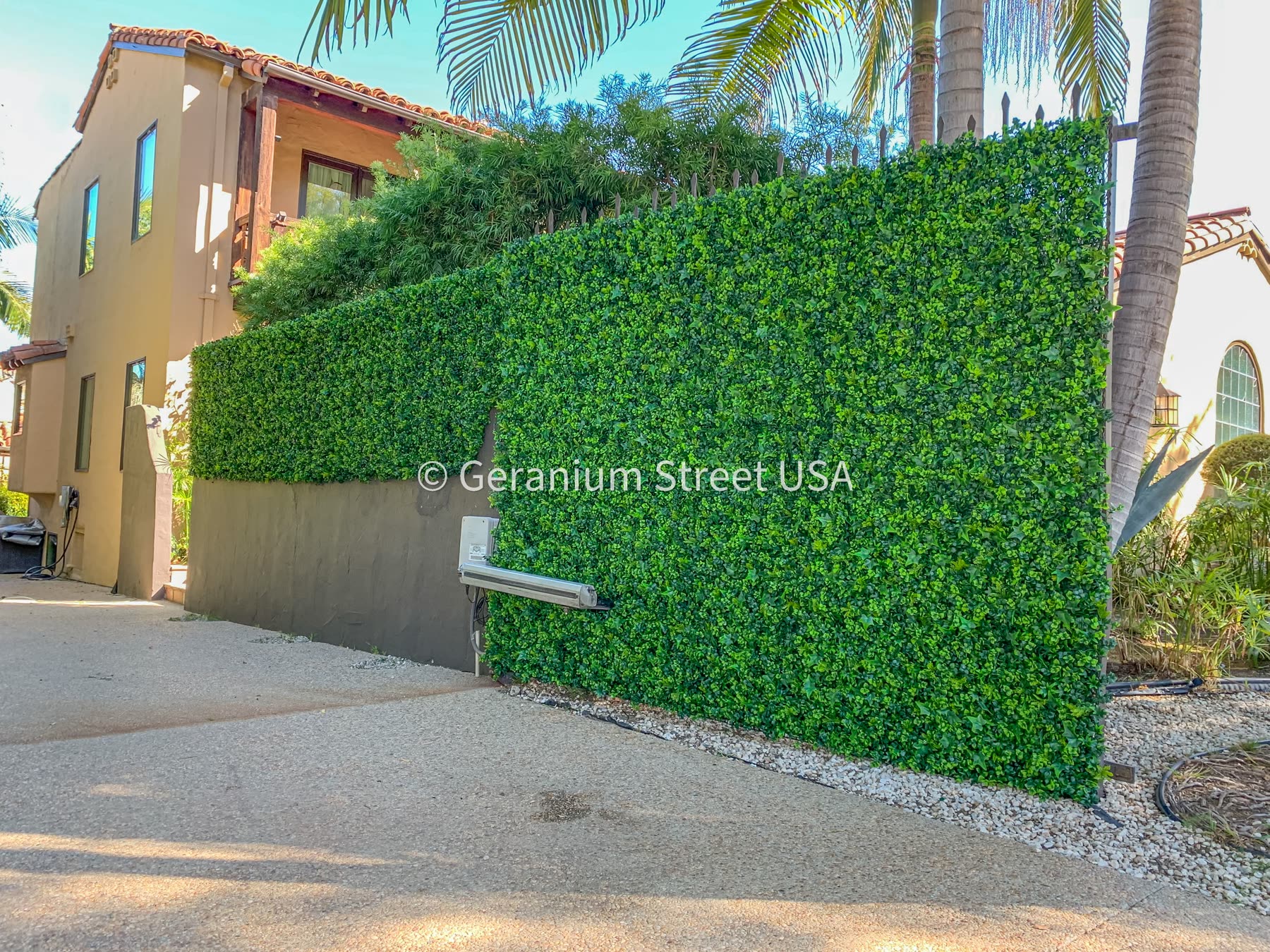
Planning a similar project? See artificial living wall installs →.
Cost: upfront vs. total cost of ownership
Planning a similar project?
Use these next pages while you read
They cover pricing, service details, and the next planning step without making you leave the article blind.
This is where the conversation usually starts and where the biggest misunderstanding lives. A real living wall is often cheaper to install. But the total cost over 5 years is a different story.
install per sq ft
maintenance per sq ft
per sq ft per year
annual maintenance
Real living wall: $175 to $250 per square foot installed, plus $1.50 to $3.00 per square foot per month in ongoing maintenance. That maintenance covers irrigation monitoring, fertilization, pruning, plant replacements, and professional visits. For a 100 sq ft wall, maintenance alone runs $1,800 to $3,600 per year.
Artificial living wall: Higher upfront cost per square foot (varies by system and foliage quality), but ongoing costs are effectively zero. A hose rinse once or twice a year is the standard recommendation.
5-year total cost for a 100 sq ft wall
The math isn't close on a 5-year horizon. Real walls cost more over time because the maintenance never stops. Artificial walls front-load the cost and then it's done.
The full comparison
| Real Living Wall | Artificial Living Wall | |
|---|---|---|
| Upfront cost | $175–250 / sq ft | Varies by system |
| Annual maintenance | $1,800–$3,600 (100 sq ft) | $0 |
| Water use | 5–12 gal / sq ft / year | Zero |
| Lifespan (outdoor TX sun) | Indefinite with maintenance | 5–10 years (UV-stabilized) |
| Air purification | Marginal (see NASA caveat below) | None |
| Biophilic benefits | Real — linked to productivity gains | Visual only |
| Appearance consistency | Varies with season and care | Consistent year-round |
| Irrigation system | Required — needs monitoring | None |
| Fire rating options | Limited by plant species | NFPA 701 rated foliage available |
| HOA approval | Usually approved | Usually approved — no irrigation mess |
| Environmental impact | Carbon absorbing, biodegradable | Plastic-based, long landfill life |
Where real walls genuinely win
We'll be straight about this. Real living walls have advantages that artificial cannot replicate:
Biophilic health benefits. Research from the University of Exeter found that office workers in environments with real plants were 15% more creative and reported 15% higher wellbeing. A study published in Scientific Reports (Nature, 2024) found positive correlations between biophilic design elements and employee wellbeing. These effects are linked to real organic material, not visual approximation.
Air quality (with a major caveat). The 1989 NASA Clean Air Study found that certain plants remove VOCs like formaldehyde and benzene from sealed chambers — in some cases reducing concentrations by up to 90%. However, the American Lung Association has clarified that these results don't translate to real buildings. You would need 10 to 1,000 plants per square meter of floor space to match the air exchange rate of normal building ventilation. A single living wall won't meaningfully clean your air.
Environmental lifecycle. Real plants are carbon-absorbing and biodegradable. Artificial plants are made from plastic, metal, and foam. The Worldwatch Institute estimates plastic production accounts for about 6% of global oil consumption. However, the environmental math is more complex than it appears — commercially grown plants require energy-intensive greenhouses, transportation, and ongoing water consumption. Neither option is environmentally free.
Where artificial walls win
Total cost of ownership. As shown above, the 5-year cost gap is significant. Artificial walls eliminate the entire maintenance line item — no labor, water, fertilizer, plant replacements, or irrigation repairs.
Consistency in Texas heat. UV-stabilized artificial foliage tested to ASTM G154 standards retains appearance for 5 to 10 years in full sun. Real plants in exterior Texas installations face 100+ degree surface temperatures, high evapotranspiration rates (documented by Texas A&M's TexasET Network), and water restrictions tracked by TCEQ. Without flawless maintenance, real walls struggle in Texas summers.
Fire rating. Artificial foliage can be manufactured with NFPA 701 Method 2 fire-rated materials and documented for code compliance. Real plants have variable fire behavior based on species, moisture content, and season. For commercial, hospitality, and multifamily applications where fire documentation is required, artificial has a clear advantage.
Zero water. In a state where the TWDB documents that 31% of residential water use goes to outdoor purposes, adding a living wall that consumes 5 to 12 gallons per square foot per year is a meaningful additional draw. Artificial uses none.
The verdict: which is right for your project?
- You have a dedicated ongoing maintenance budget
- The wall is interior with controlled climate
- Biophilic wellbeing benefits matter (office, healthcare)
- You have reliable water supply and good drainage
- The wall has easy access for monthly service
- Environmental lifecycle is a top priority
- The wall is exterior in Texas sun
- There's no irrigation infrastructure available
- Maintenance budget is limited or zero
- Fire-rated documentation is required
- HOA requires consistent year-round appearance
- You need a pool, patio, or fence-line wall
- The space is in a water-restricted area
Most of the artificial walls we install in Dallas, Fort Worth, Houston, and San Antonio fall into one of those right-column scenarios. But when a client has the budget and conditions for real, we'll tell them so.
Related reading
- Green wall maintenance costs in Texas — detailed maintenance costs and schedule
- Artificial living walls — our product page with system details
- The complete guide to artificial living walls in Texas — types, materials, and installation
Sources
See our artificial living walls page to compare options, or explore installations in Dallas, Fort Worth, Houston, and San Antonio.
Need a next step?
Need a real starting number for your project?
Use the pricing page for quick benchmarks, then send dimensions and photos for a tighter range.
Ready for the next step?
Use the page that fits your project best
Pick the shortest path based on whether you need pricing, a service page, or a local planning page.