Introduction
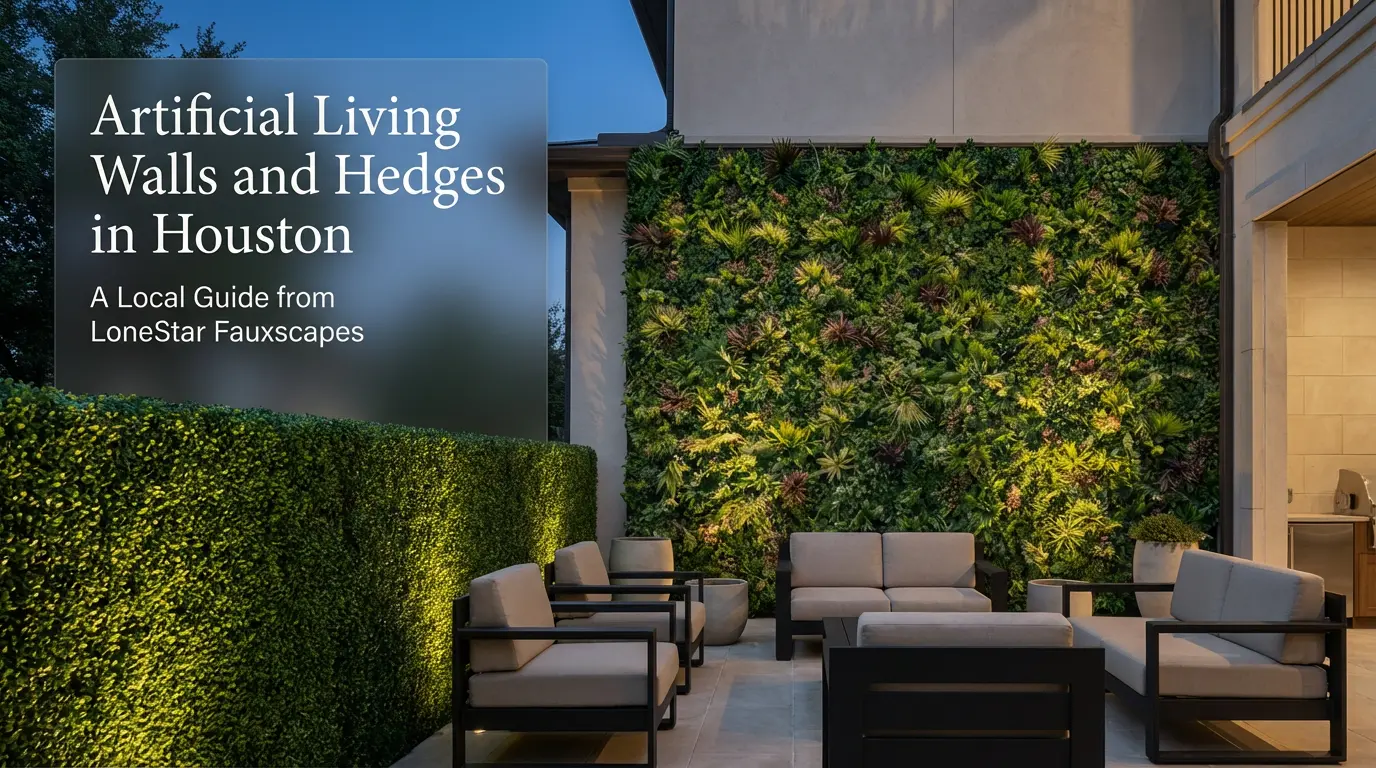
If you’ve tried to keep a real plant wall alive in Houston, you know how it goes: the heat ramps up, the humidity never really leaves, and one small irrigation issue can turn a “lush moment” into a brown mess in a week. That’s why more property owners are looking at Artificial living walls and Artificial hedges in Houston—something that looks green from day one and still looks tidy after a July heat wave.
This guide is written for Houston, not “any city.” You’ll learn where faux living walls and fake hedges actually make sense here (homes, restaurants, offices, patios), what “fire rated” usually means in real projects, and what to ask a provider before you pay. I’ll also get into Houston-specific stuff like UV exposure, hurricane season prep, and where people are putting these in places like The Heights, River Oaks, and Midtown.
Planning a similar project? See artificial hedge installs → and the Houston city page.
You’ll see LoneStar Fauxscapes mentioned throughout because that’s the business this post is about—but the point is simple: help you make a smart choice that holds up in Houston.
1. The artificial living wall and hedge scene in Houston
Planning a similar project?
Use these next pages while you read
They cover pricing, service details, and the next planning step without making you leave the article blind.
Houston has always leaned indoor-outdoor, but keeping real greenery looking good here is a different job than it is in somewhere like San Diego. Intense sun, heavy rain bursts, and long humid stretches make live walls and live hedges high-maintenance. So a lot of people end up choosing materials that can take the climate without needing constant care.
A few places where faux living walls and artificial hedges show up a lot around Houston:
In restaurant and bar buildouts, a green wall is a straightforward way to soften hard surfaces—brick, concrete, tile—without building your schedule around watering and plant drop. You see this around entertainment-heavy areas near Washington Ave and into Midtown, where patios and indoor seating need privacy and something easier on the eyes.
In office lobbies and shared spaces, artificial living walls are often used as a clean-looking backdrop for branding or photos. In Houston, that usually means it has to look good under harsh overhead LEDs. When people try to do a live wall indoors, the lighting and irrigation gear quickly become the real project. Faux avoids most of that.
At homes—especially in neighborhoods like The Heights—privacy hedges and balcony screens come up a lot. People want to block a neighbor’s window line or cover an ugly fence without eating up patio space.
And then there’s a very Houston thing: outdoor areas that sit in shade most of the day and then get blasted by sun for a few hours. Live plants often wear unevenly in that setup. Artificial panels, if you pick decent material and the install is done right, stay consistent.
If you’re planning installs near spots like Buffalo Bayou Park or along corridors feeding into downtown (think around I-10 and Studemont), you’ll also notice a practical design trend: greenery that photographs well without needing a crew to keep it alive. That’s part of why companies like LoneStar Fauxscapes get steady calls for artificial living walls and artificial hedges in Houston.
2. Why Houston residents choose artificial living walls and artificial hedges
Most people don’t set out looking for “fake plants.” They want an end result—privacy, a cleaner patio, a statement wall in a lobby—without signing up for a maintenance routine.
The heat and humidity are real (and they beat up live installations)
Houston’s long hot season is the obvious part. But it’s the combo—heat plus humidity plus sudden downpours—that makes live wall performance hard to predict. Even when plants survive, the wall can look patchy: some sections thrive, others struggle. Artificial living walls stay visually even across the whole surface.
Less water, less mess, fewer callbacks
Live walls and live hedges can look great, but they’re systems: irrigation, drainage, lighting, fertilizer, pest control, and replacement plants. That’s a lot of parts that can fail.
Artificial hedges and faux living walls remove most of the “wet” work. In Houston, where moisture management is already a constant—patios, covered outdoor kitchens, stucco walls, fence lines—people like options that don’t add more water problems.
Privacy without waiting a year (or three)
A real hedge takes time to fill in. Houston grows fast, but it still isn’t instant. Artificial hedges solve the “I need privacy now” problem for:
- Townhome patios with close sightlines
- Pool equipment areas you’d rather not stare at
- Dumpster enclosures and service corridors behind retail
Fire-rated options for commercial spaces
For a lot of Houston businesses, the question isn’t only “Does it look good?” It’s “Will this pass inspection?”
If you’re putting greenery inside a restaurant, event space, hotel, or office lobby, someone may ask about fire performance. That’s where fire rated living walls come in.
Two practical notes:
First, “fire rated” isn’t a vibe—it needs paperwork. You want product specs, the test standard used, and clear installation guidance.
Second, fire ratings don’t override code compliance for the space. Sprinklers, exits, clearances, and the local AHJ (authority having jurisdiction) still decide what’s allowed. But if you’re shopping for faux living walls in Houston for a commercial buildout, fire-rated materials can save you from expensive last-minute changes.
That’s one reason buyers often look for local help: they don’t want a decorative feature that turns into a permit problem.
3. What to look for in a Houston provider (so you don’t regret it)
There are plenty of “panel in a box” options online. Some are fine for a short-term event backdrop. But if you want something that still looks good under Houston sun and humidity, who you buy from (and who installs it) matters.
Ask about UV resistance in plain language
Houston sun can fade cheaper plastics quickly. When a provider says “UV resistant,” ask what that means for your wall:
Is it full afternoon sun on a west-facing wall? Under a pergola? Indoors behind glass where heat builds up?
A good provider will talk through placement and realistic expectations instead of promising it’ll look perfect forever.
Check how panels are joined (this is where bad installs scream “fake”)
Seams are usually the tell. On a big wall, the difference between “that looks real” and “that’s obviously panels” often comes down to how the joins are handled.
Look for tight alignment, consistent direction, and a plan for corners and edges. If the install includes trim, clean edge finishing, or mixed textures to break up repeating patterns, you’re in better shape.
Fire-rated documentation for commercial jobs
If you’re building in Midtown, Downtown, or along busy retail strips where inspections can be more strict, don’t wait until the final walkthrough to ask about fire performance.
Ask for:
- Product spec sheets
- Any fire testing documentation the manufacturer provides
- A clear statement of what’s rated (the plant material, the backing, or both)
If they can’t provide documentation and you need it, keep looking.
Mounting and substrate: Houston walls aren’t all the same
Houston properties vary a lot. You might be mounting onto:
- Brick (older Heights homes)
- Stucco
- Metal fencing
- Concrete block
- Drywall (indoors)
Each surface needs a different approach so panels don’t warp, pull away, or trap moisture where it shouldn’t be. If a provider treats every job the same, that’s a warning sign.
Real-world maintenance guidance
Even artificial greenery needs occasional cleaning—especially in Houston, where pollen, dust, and mildew can show up.
A provider worth paying for will tell you what cleaning looks like (for example: rinse, mild soap, soft brush, avoid harsh chemicals), and how often depends on whether you’re near a busy road, under trees, or getting hit by sprinkler overspray.
That’s a big part of why people hire LoneStar Fauxscapes instead of ordering random panels: you’re paying for the install decisions, not just the material.
4. Houston area-specific considerations (the stuff that changes decisions here)
Houston is a design city, sure—but it’s also a “what holds up here” city. These local constraints really do change what makes sense for artificial living walls and faux hedges.
Hurricane season and wind load
If you’re mounting a hedge wall on fencing or adding a living wall feature on an exterior facade, wind matters. Panels need solid attachment points, and the substrate has to handle gusts and vibration.
If you’re in more exposed areas—closer to bayous or big open corridors—treat outdoor installs like exterior cladding, not indoor decor.
Humidity, mildew, and where water collects
Houston humidity isn’t just annoying. It helps grime and mildew build up, especially where airflow is poor.
Two common trouble spots:
Covered patios where the wall stays shaded and damp after rain, and fence lines where sprinklers hit daily. In both cases, you want materials that clean easily and an install that doesn’t create little pockets where water can sit behind the panels.
Sun angles and west-facing walls
A west-facing wall in Houston can get hammered by afternoon sun. If your project is in River Oaks with an exposed patio wall, or a Heights yard with limited shade, assume higher UV exposure and a higher risk of fading.
Sometimes the most Houston-friendly move is mixing textures: use a denser faux hedge where you need privacy, and a more varied faux living wall pattern where you want depth and less obvious repetition. It also helps disguise minor fade over time.
HOA and neighbor sightlines
In a lot of Houston neighborhoods, HOA rules or deed restrictions can limit what you can attach to fences or exterior walls. Artificial hedges often work as “soft privacy” because they read like landscaping instead of a new structure.
If you’re in a townhome-heavy pocket near major corridors, check whether you’re allowed to attach to the fence line or if you’ll need a freestanding frame.
Local numbers that shape the decision
Houston is big. The U.S. Census Bureau puts the City of Houston population at roughly 2.3 million (recent estimates shift year to year, but it stays over two million). That size matters because dense neighborhoods, tight setbacks, and lots of multifamily properties create steady demand for privacy screening and low-maintenance “green” design.
On the climate side, NOAA data for Houston (Hobby and Bush-area climate normals) matches what residents already feel: long hot seasons, heavy rain events, and high humidity. You don’t need a lab report to know what that does to live plant walls.
5. Getting started with artificial living walls and artificial hedges in Houston
If you’re ready to price a project, you’ll get a faster (and cleaner) quote if you answer a few Houston-specific questions first.
Start with whether it’s mainly an indoor or outdoor install. Indoors is usually about realism under your lighting and, for commercial spaces, fire-rated requirements. Outdoors is usually about UV exposure, wind, and how you’ll clean it.
Next, measure the surface and take photos straight-on and from the sides. Capture what’s around it too—outlets, hose bibs, lighting, fence posts. In Houston, patios often have odd features (gas lines, outdoor kitchens, covered rooflines) that affect mounting.
Then, pick the job type:
If you want privacy, faux hedges are usually the simplest route. If you want a focal wall—entry, lobby, selfie wall—an artificial living wall pattern tends to look more intentional.
Finally, talk through finish details like edges, corners, and transitions. That’s where a wall either looks custom or looks like a kit.
For homeowners in The Heights or River Oaks, it’s often a patio privacy wall or a fence upgrade. For businesses in Midtown, it’s often an interior branded wall or a patio divider. LoneStar Fauxscapes can walk you through those choices with Houston conditions in mind.
Conclusion: a Houston-ready green wall that doesn’t become a project
If you want greenery that stays consistent through Houston heat, humidity, and the messy realities of outdoor living, artificial living walls and artificial hedges are a practical option. The difference-maker is materials that won’t fade quickly and an install that won’t peel, gap, or trap moisture.
If you’re in Houston and weighing options, reach out to LoneStar Fauxscapes for a recommendation based on your site. Share your wall size, a few photos, and whether you need fire rated living walls for a commercial space. You’ll get guidance that fits Houston conditions instead of generic advice.
See our full Houston artificial hedges and living walls page for project photos and local details, or explore options in Dallas, San Antonio, and Sugar Land.
Need a next step?
Need fire-rated options or documentation?
Send the wall size, project type, and timeline. We can tell you when fire-rated foliage or documentation belongs in the scope.
Ready for the next step?
Use the page that fits your project best
Pick the shortest path based on whether you need pricing, a service page, or a local planning page.